Why Choose Simplex Chains for Your Manufacturing Line

Manufacturing Engineering

A detailed engineering and commercial case for simplex roller chain as the primary drive element for Australian manufacturing lines β€” from design advantages through to operational reliability and long-term value.

Technical Specifications for Manufacturing Line Simplex Chains

Manufacturing lines in Australia span a vast range of production types β€” from high-speed packaging at 600 RPM to heavy-duty press lines at 50 RPM. The table below maps the most common simplex chain specifications to the production categories where each delivers optimal performance, integrating the key parameters that manufacturing engineers use to validate drive selections against their production requirements.
Manufacturing Category Chain Spec Pitch (mm) Tensile (kN) Typical Speed Key Feature Material
Food packaging / beverage 06B-1 / 08B-1 9.5–12.7 8.9–17.8 300–600 RPM Sealed, wash-down safe SS304 / SS316
Metal stamping / presswork 12B-1H / 16B-1H 19.0–25.4 35–72 50–200 RPM Heavy-series shock rated Case-hardened alloy
Timber / lumber processing 16B-1 / 20B-1 25.4–31.75 60–95 100–300 RPM Corrosion-resistant Nickel-plated or Zn-Ni
Chemical / pharmaceutical 10B-1 / 12B-1 15.9–19.0 22–29 150–400 RPM Chemical resistance SS316 / PTFE-coated
Automotive assembly 08B-1 / 12B-1 12.7–19.0 17.8–28.9 200–500 RPM Precision indexing Case-hardened alloy
Concrete / building materials 16B-1 / ANSI 80 25.4 57.8–60 80–200 RPM Dust and grit resistant Self-lubricating SL
Electronics / precision assembly 06B-1 / 08B-1 9.5–12.7 8.9–17.8 400–800 RPM Zero-lube, clean room SS304 / sintered SL

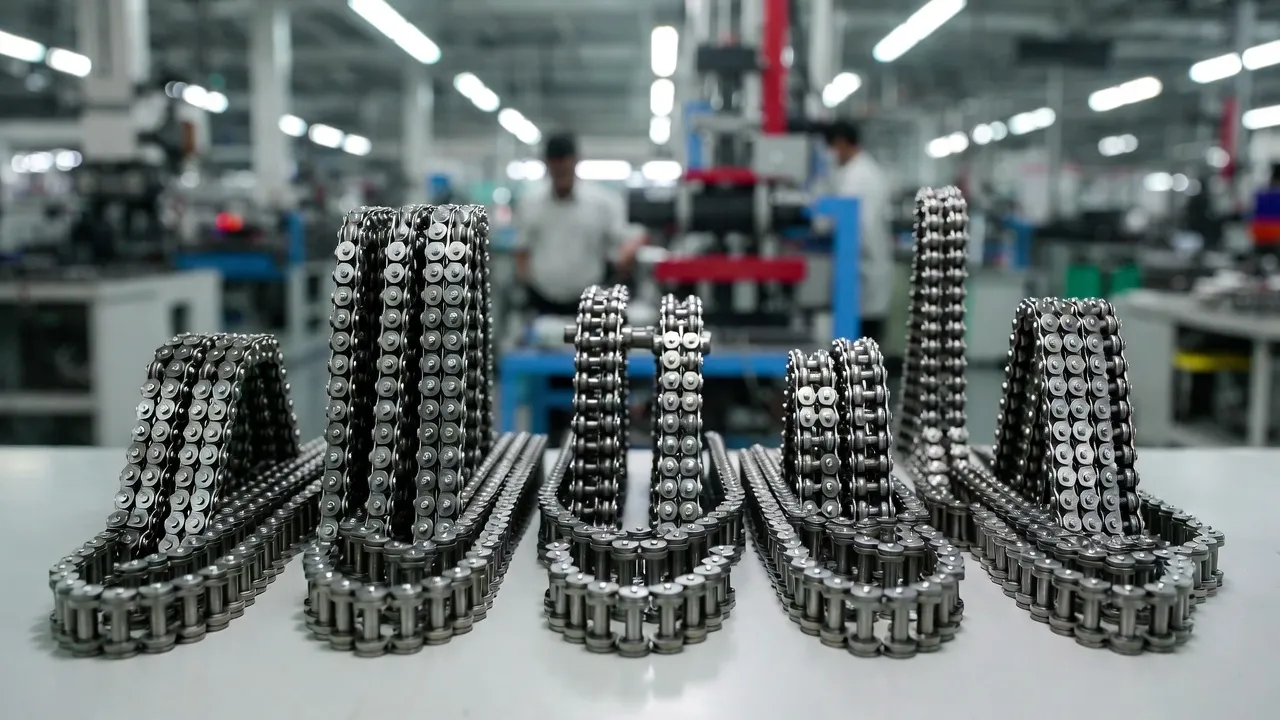
Simplex chain manufacturing line production drive system Australia

Seven Reasons Manufacturing Engineers Specify Simplex Chain

When Australian manufacturing engineers evaluate drive system options for a new production line β€” or an upgrade to an existing facility β€” simplex roller chain consistently appears in the final specification. Understanding the engineering and commercial reasons behind this preference helps production managers and procurement teams make better-informed specification decisions.

🎯

Exact, Non-Slip Transmission Ratio

Manufacturing lines depend on precise synchronisation between production stations β€” a conveyor running 2% faster than design speed misaligns labels, causes bottle cap failures, or produces dimensional errors in pressed components. Simplex chain provides a fixed, positive transmission ratio with zero slip under any load condition within the chain’s rated capacity. Belt drives cannot match this consistency because friction-based engagement allows load-dependent creep that shifts the effective ratio under varying production loads.

⚑

High Power Density

Simplex chains transmit far more power per unit of drive width than belt drives. A 16B-1 simplex chain 17 mm wide transmits up to 12 kN of force β€” equivalent to a V-belt drive requiring three B-section belts across a 60 mm pulley width. This compact power transmission is a significant manufacturing floor space advantage when drive systems must fit within constrained machine envelopes on high-density production lines.

πŸ”§

Field-Maintainable with Standard Tools

Unlike toothed belt drives that require manufacturer-specific replacement procedures and pulleys, simplex chain maintenance requires only a chain breaker, a chain press, and a wear gauge β€” tools that cost under $200 and can be used across every chain size on the production floor. Any competent maintenance technician can perform a chain replacement with minimal training, reducing reliance on specialist contractors for routine maintenance events.

πŸ“

Short Centre Distance Flexibility

Manufacturing machine design frequently requires drives between shafts separated by distances too short for belt drives to achieve adequate wrap angle. Simplex chain can operate on centre distances as short as 30 times the chain pitch (approximately 570 mm for 12B-1) with standard 17-tooth sprockets, without the belt drive’s minimum centre-distance constraint driven by pulley wrap requirements. This flexibility significantly simplifies machine layout on multi-drive production equipment.

πŸ›‘οΈ

Predictable Wear and Replaceability

Simplex chain wear is a linear process measurable with a simple gauge, progressing at a rate that can be trended over time. This predictability allows manufacturing maintenance teams to schedule replacements during planned production shutdowns with high confidence β€” unlike bearings or gears, which can fail suddenly with minimal warning. The wear-rate data generated during normal operation becomes the basis for optimised replacement planning across an entire facility.

πŸ’‘

Wide Environmental Adaptability

No other drive element type covers as wide an environmental range as simplex chain. Stainless variants for food and chemical environments, self-lubricating for dusty and remote applications, zinc-nickel plated for coastal and humid exposure, ATEX-rated for explosive atmospheres β€” all using identical sprocket engagement geometry. A manufacturing facility can standardise on simplex chain across departments with vastly different environmental requirements without introducing multiple drive system types.

πŸ’°

Lowest Total Cost of Ownership

Across the majority of manufacturing line drive applications in the 1–75 kW range, premium-grade simplex chain delivers the lowest 5-year total cost of ownership compared with V-belt, toothed belt, and gear-train alternatives β€” combining high efficiency (97–99%), moderate capital cost, field maintainability, and long service life when correctly specified and maintained. The lifecycle cost advantage over V-belt is typically 20–35%; over toothed belt in shock-load applications, 15–25%.

Where Simplex Chains Are Used on Australian Manufacturing Lines

Manufacturing lines integrate simplex chain drives at multiple positions, each with distinct performance requirements. The following section covers the three most common drive positions and the engineering rationale for chain use at each location.

Main Line Drive Shafts

The primary drive shaft of a manufacturing line conveyor or indexing system carries the full accumulated load from all downstream stations β€” product weight, friction at each station, and the startup inertia of the entire line. A 12B-1 or 16B-1 simplex chain from the main gearbox to the drive shaft is the standard configuration for lines operating at 100–300 RPM. The chain’s combination of high load capacity, exact ratio, and compact width allows the gearbox to be positioned close to the drive shaft without requiring an inline coupling or a complex secondary gearbox stage. For production lines with variable load signatures β€” where product types change between runs β€” the simplicity of adjusting takeup tension to accommodate different chain elongation rates under different load profiles is a practical advantage that gear-coupled drives cannot offer.

Cross-Line Synchronisation Drives

Parallel conveyor lanes on multi-lane production lines must run at precisely identical speeds to prevent product misalignment, skewing, and transfer failures at merge points. Simplex chain cross-shaft drives maintain absolute synchronisation between lanes because the positive engagement eliminates the speed differential that friction belt drives develop under uneven lane loading. A single cross-shaft driven by one simplex chain, distributing drive torque to both lane drive sprockets through a common shaft, is the most reliable synchronisation solution for moderate-speed (200–400 RPM) multi-lane lines. The cross-shaft chain requires careful alignment maintenance β€” lateral misalignment on cross-shaft drives accumulates across the full shaft span and should be checked quarterly on continuous production lines.

Station Indexing and Transfer Drives

Indexing mechanisms β€” transfer conveyors, walking-beam drives, and rotary tables β€” use simplex chains to achieve precise step-by-step positioning of components through machining, assembly, or inspection stations. Short-pitch simplex chains (06B-1 or 08B-1) with high tooth-count sprockets (21–25 teeth minimum) maintain the positional accuracy required for robotic pick-and-place operations and vision-based inspection systems. The chain’s consistent pitch β€” maintained within manufacturer tolerance throughout its service life until the replacement threshold is reached β€” provides predictable indexing accuracy that allows vision system calibration to remain valid between chain replacement events.

Simplex chain manufacturing line indexing synchronisation drive

Integrating Simplex Chain Drives into Manufacturing Line Design

Effective simplex chain integration into a new or upgraded manufacturing line follows a structured engineering process. The following steps reflect current design practice on Australian manufacturing line projects.

1

🏭 Define Production Requirements

Document: line speed (m/min or products/min), product weight and dimensions, transfer force requirements at each station, indexing accuracy requirements, environmental conditions (temperature, humidity, wash-down, dust), and daily operating hours. These parameters define the chain specification and lubrication system without ambiguity.

2

βš™οΈ Select Drive Configuration

Determine the gearbox-to-drive-shaft transmission ratio required for the target line speed. Confirm that this ratio can be achieved in a single chain stage (max 6:1) or requires two stages. Select the chain pitch from the power rating chart at the drive shaft RPM and the design power (transmitted power Γ— service factor). Confirm working tension is within allowable load.

3

πŸ“ Size Sprockets and Layout

Select sprocket tooth counts (minimum 17 on driver; 21+ for precision indexing). Calculate pitch circle diameters and confirm the physical centre distance fits within the machine envelope. Design the takeup mechanism β€” spring-loaded idler or adjustable bearing housing β€” with sufficient adjustment travel to accommodate run-in elongation and the full service life elongation of 2%.

4

πŸ›’οΈ Design Lubrication System

Select the lubrication method appropriate for the chain speed and environment. For enclosed manufacturing drives at 200–600 RPM, specify an oil-bath casing. For accessible drives below 200 RPM, a drip-feed oiler. For food environments, specify sealed or sintered-bush chains with food-grade lubricant. For dusty environments, specify self-lubricating chains without external oil. Document the maintenance interval and lubricant specification in the machine manual.

5

πŸ“‹ Specify Maintenance Programme

Include in the machine documentation: as-installed 30-link elongation baseline, inspection intervals, elongation replacement threshold, lubricant specification, and connecting link type. Provide the maintenance team with a chain wear gauge calibrated to the installed chain pitch. Specify the replacement chain size, series, and length in pitches to eliminate specification ambiguity at the first replacement event.

6

πŸ“¦ Establish Spare Parts Stock

Specify minimum on-site spare parts: one complete replacement chain circuit for each critical drive, matching connecting links, and the appropriate press or clip tool for the connecting link type. For lines operating three shifts, specify that spare parts are reviewed and replenished within 48 hours of any emergency use β€” not at the next scheduled purchasing cycle.

Simplex Chain vs Belt and Gear Drives: A Manufacturing Line Comparison

Manufacturing engineers frequently evaluate simplex chain against V-belt, toothed belt, and gear drives for the same application. The decision depends on the specific requirements, but several properties differentiate chain from alternatives in ways that matter specifically for production line applications.

Property Simplex Chain V-Belt Toothed Belt Gear Drive
Exact transmission ratio βœ… Yes ❌ Slip βœ… Yes βœ… Yes
High torque at low-medium speed βœ… Excellent ⚠️ Moderate ⚠️ Moderate βœ… Excellent
Short centre distances βœ… Yes ❌ Needs wrap ❌ Needs wrap βœ… Yes
Field maintainable (standard tools) βœ… Yes βœ… Yes ⚠️ Moderate ❌ Specialist
Predictable wear / measurable life βœ… Excellent ⚠️ Moderate ⚠️ Moderate ⚠️ Gear wear less visible
Shock load tolerance βœ… Excellent (H-series) ⚠️ Some slip ⚠️ Risk of tooth skip βœ… Excellent
Capital cost βœ… Low–Medium βœ… Low Medium ❌ High

How Simplex Chain Drives Improve Manufacturing Line Productivity

Manufacturing productivity is determined by two factors: the speed at which the line runs and the proportion of scheduled time that it actually operates. Simplex chain drives contribute to both metrics in ways that are measurable against production records.

πŸ“ˆ

Consistent Line Speed

Positive engagement eliminates the speed variation that causes quality defects downstream. On food processing lines, this consistency is directly linked to fill accuracy, seal quality, and label registration. On assembly lines, it determines whether robotic placement arms reach the correct position relative to moving components.

⏱️

Planned Maintenance Windows

The measurability of simplex chain wear allows maintenance teams to schedule replacements at planned production changeover windows rather than reacting to failures during production runs. A line that changes products every 4 hours on a 3-shift schedule has 18 planned changeover windows per week β€” each a potential 10-minute chain inspection slot that can prevent a multi-hour unplanned stoppage.

πŸ”

Fast Changeover on Multi-Product Lines

When a manufacturing line changes between product formats, drive speed adjustments are made through the variable-speed motor and gearbox β€” the chain drive geometry remains unchanged. This is faster than belt drive adjustments, which may require belt tension changes or pulley swaps when speed ratios change significantly between product formats.

πŸ”‡

Noise Compliance

Correctly specified and maintained simplex chain drives in enclosed casings contribute 75–82 dB(A) to facility ambient noise β€” within the AS/NZS 1269 hearing protection threshold of 85 dB(A) averaged over 8 hours. This eliminates the administrative burden of hearing conservation programmes for workers in the immediate vicinity of enclosed chain drives.

For engineering consultation on simplex chain drive design for Australian manufacturing lines β€” including chain selection, sprocket specification, lubrication system design, and maintenance programme development β€” visit Gear Drive Australia’s manufacturing drive resources or contact our technical team directly.

Speak with the engineering team at Gear Drive Australia to review your manufacturing line drive specifications β€” we provide chain selection, lubrication system recommendations, and ongoing supply support for Australian production facilities of all sizes.

Frequently Asked Questions

Why is simplex chain better than V-belt for a manufacturing line? +
The primary manufacturing advantage of simplex chain over V-belt is positive engagement β€” the chain does not slip under load, whereas a V-belt drive allows load-dependent creep that shifts the effective transmission ratio. On a production line where speed accuracy affects product quality, fill weight, label placement, or assembly positioning, this slip-free characteristic is not optional. Secondary advantages include higher power density (chain transmits more force per unit of drive width), the ability to operate on shorter centre distances, and significantly longer service life with predictable wear progression. The efficiency advantage of chain (97–99%) over V-belt (93–96%) also becomes meaningful on high-power continuous drives where a 3–4% efficiency difference represents measurable annual energy savings. V-belt retains a cost advantage for non-critical, low-power, easily accessible drives β€” but on the primary synchronised drives of a production line, chain is the technically superior specification.
How does simplex chain affect manufacturing line OEE (Overall Equipment Effectiveness)? +
OEE is the product of Availability, Performance, and Quality β€” and simplex chain drives influence all three. Availability improves because chain wear is measurable and manageable through planned replacement, reducing unplanned downtime events compared with belt drives (which can fail suddenly without the same warning signs) and gear drives (which require specialist maintenance). Performance is maintained because chain does not slip under variable load, ensuring consistent line speed and production rate. Quality improves on speed-sensitive processes because consistent transmission ratio produces consistent product dimensions, fill weights, and positional accuracy. Manufacturing lines in Australian food, packaging, and automotive sectors have reported OEE improvements of 3–8% after converting from V-belt primary drives to simplex chain, primarily through the reduction in unplanned stoppages and improved consistency of quality metrics that require re-inspection or rework when line speed varies.
What maintenance schedule is realistic for simplex chain on a 24/7 production line? +
A realistic maintenance schedule for simplex chain on a 24/7 manufacturing line combines several activities at different intervals. At each shift change (approximately every 8 hours), a 3-minute walk-by inspection checks for unusual noise, visible chain damage, and any obvious lubrication failures β€” this requires no tools and catches the most urgent issues. Weekly, a 10-minute inspection verifies the lubrication system is delivering at the correct rate, checks slack-strand sag against the 2–3% specification, and looks for visible roller damage or misalignment signs. Monthly, a 20-minute inspection measures 30-link elongation and records it against the wear-rate trend. At the first planned production stop showing elongation above 1.5%, schedule chain and sprocket replacement β€” this typically requires 2–4 hours. Oil bath casings are drained and refilled quarterly. This schedule is compatible with three-shift Australian manufacturing operations without requiring production stops dedicated to maintenance.
Can simplex chain drive a variable-speed manufacturing line? +
Yes β€” simplex chain is fully compatible with variable-speed drives (VSDs) on manufacturing lines. The chain simply transmits whatever speed the motor and gearbox deliver, without any speed-dependent performance limitation within the chain’s rated speed range. The chain selection must be validated at the lowest operating speed (highest torque for given power), the highest operating speed (highest chain velocity), and any intermediate speed where dynamic loading is elevated β€” such as acceleration ramps. Variable-speed drives on manufacturing lines also change the lubrication requirement: at lower speeds, the hydrodynamic oil film in the chain joints is less well-developed, potentially requiring a slightly higher-viscosity lubricant than would be selected for fixed-speed operation at the maximum speed. For lines varying between 50% and 100% of maximum speed, a lubricant grade appropriate for the mid-speed range typically provides adequate protection across the full operating range.
What simplex chain type is best for a food manufacturing production line? +
For food manufacturing production lines in Australia, the specification is governed primarily by FSANZ food safety regulations, which require that drive components in food contact or food splash zones be manufactured from food-safe materials and not contribute lubricant contamination risk to the product. SS304 stainless simplex chains with sintered bush construction (self-lubricating) eliminate both the corrosion risk from wash-down chemicals and the lubricant contamination risk from external oil application. This combination suits the majority of Australian food manufacturing drive positions where the chain is in or near the food zone. For drive positions clearly outside the food zone β€” enclosed gearbox secondary drives, for example β€” standard carbon-steel chains with appropriate lubrication are acceptable and more cost-effective. For drives in cold-storage environments (below 5Β°C), confirm that the chain lubricant specified retains adequate viscosity at the operating temperature β€” standard chain oils viscosity-increase significantly below 10Β°C and may not penetrate the pin-bush interface effectively at cold-storage temperatures.
How does simplex chain handle shock loads on a manufacturing line? +
Simplex chain handles shock loads through two mechanisms. First, the inherent elasticity of correctly tensioned chain β€” a catenary of small steel elements β€” absorbs a fraction of the shock energy through dynamic deflection of the slack strand, spreading the tension impulse over a longer time interval than a rigid coupling would. Second, heavy-series chains (H-suffix) with thicker side plates distribute the shock-induced stress over a larger plate cross-sectional area, maintaining stress levels below the fatigue limit under repeated shock events. For manufacturing drives with defined shock characteristics β€” stamping presses, baling machines, reciprocating conveyors β€” the chain is selected with a service factor of 1.5–2.0 applied to the nominal power, which reserves fatigue capacity for the additional dynamic load. For shock loads of unpredictable severity, an upstream slip clutch or mechanical overload device limits the peak torque transmitted to the chain, preventing the occasional extreme event from generating a chain-breaking tension spike regardless of how the drive is rated.
Can I retrofit simplex chain to an existing belt-drive manufacturing machine? +
Retrofitting simplex chain to an existing belt-drive machine is technically feasible in most cases but requires engineering assessment of the existing drive geometry. The key parameters to verify are: centre distance (chain drives can be installed on shorter centres than belt drives, so existing belt centres are generally compatible); shaft diameter and keyway dimensions (sprockets must fit the existing shafts, or shaft adapters must be fabricated); bearing load capacity (chain drives impose lower radial bearing loads than equivalent V-belt drives because chain does not require the pre-tension that belts need β€” retrofitting chain can actually reduce bearing loads and extend bearing life); and available space for the sprocket diameter (chain sprockets are typically larger in diameter than the equivalent belt pulleys for the same transmission ratio, so confirm clearance exists in the machine frame). Most belt-to-chain retrofits on Australian manufacturing lines are completed within a single planned maintenance shift when the engineering assessment has been completed in advance, and the payback in extended service life and consistent line speed is typically evident within the first three months of operation.
What causes simplex chain noise on a manufacturing line and how is it controlled? +
Simplex chain noise on manufacturing lines comes from three sources: roller-tooth engagement impact at the drive sprocket, chain resonance on the slack strand between sprockets, and chain-guide contact on guided sections. Engagement impact is the dominant noise source and increases with chain speed, chain pitch, and decreasing sprocket tooth count. The most effective controls in manufacturing environments are: increasing sprocket tooth count (moving from 17 to 25 teeth reduces engagement noise by 4–6 dB), enclosing the drive in an oil-bath casing (10–14 dB reduction), and using polyurethane or rubber-cushion sprockets (3–6 dB reduction). Slack-strand resonance is controlled by guide pads at 1/3 and 2/3 of the slack-strand length. The combined effect of these measures on an enclosed 12B-1 chain drive can reduce the drive noise contribution from 88–92 dB(A) on an open drive to 74–78 dB(A) on a fully enclosed, guide-fitted drive β€” bringing the drive below the AS/NZS 1269 threshold where hearing protection becomes mandatory, and significantly improving the overall factory floor acoustic environment.
How should I choose between ISO and ANSI simplex chain for a new manufacturing line? +
For a new manufacturing line where no legacy equipment constrains the choice, selecting the standard with better local supply availability is the primary consideration β€” in Australia, ISO metric chains (06B through 32B) have broader distributor stocking than ANSI chains in the smaller pitch sizes. If other equipment in your facility already uses one standard, standardising all new machinery on that standard simplifies spare parts inventory significantly. If the machine is being supplied by an international OEM β€” particularly American-specification equipment β€” ANSI chain is more likely to be specified for the drives, and using ANSI chain maintains compatibility with OEM sprocket tooling. The only technical difference relevant to new machine design is a slight dimensional variation in roller diameter and inner link width between the two standards at the same nominal pitch β€” ISO B-series tends to have marginally higher tensile ratings in smaller pitch sizes, while ANSI chains dominate the North American aftermarket. For most Australian manufacturing applications, either standard is technically equivalent, and the selection can be driven entirely by supply and standardisation considerations without performance compromise.
What is the minimum sprocket tooth count for high-speed manufacturing line drives? +
The engineering minimum is 17 teeth on the driver sprocket for all simplex chain drives β€” below this count, the polygon-effect velocity variation exceeds 2.7%, which generates audible noise and measurable vibration even at moderate chain speeds. For manufacturing line applications where precision indexing accuracy is required (vision inspection systems, robotic assembly, high-accuracy filling), the effective minimum is 21–25 teeth, which reduces velocity variation below 1.8% and 1.3% respectively. At speeds above 400 RPM, increasing tooth count from 17 to 21 also moves the roller-tooth engagement frequency above the primary natural frequencies of most machine frames, avoiding the resonance that can amplify noise and vibration dramatically on lightly-damped production line structures. Larger sprockets increase the pitch diameter and therefore reduce the transmission ratio achievable in a single chain stage β€” this constraint is usually managed by adjusting the gearbox output speed to compensate for the sprocket change, or by accepting a two-stage chain reduction where the drive layout permits.
Tags:

Recent Posts

gear-drive

As one of leading gear-drive manufacturers, suppliers and exporters of mechanical products, We offer gear-drive and many other products.

Please contact us for details.

Mail:[email protected]

Manufacturer supplier exporter of bush chains

We specializing in the production of Agricultural Gearbox, PTO Shafts, Sprockets, Fluid Coupling, Worm Gear Reducers, Gears and racks, Roller Chains, Sheave and Pulleys, Planetary Gearboxes, Timing Pulleys, Shaft Collars and more.

We have exported our products to clients around the world and earned a good reputation because of our superior product quality and after-sales service.

We warmly welcome customers both at home and abroad to contact us to negotiate business, exchange information and cooperate with us.