Technical Specifications: Maintenance-Free Simplex Chain Types
Maintenance-free simplex chains are not a single product category but a family of technologies that address the lubrication challenge through different engineering approaches. The table below maps the available maintenance-free configurations to their technical specifications, operating limits, and the specific application demands they address most effectively across Australian industry.
| Chain Type |
Technology |
Lube-Free Interval |
Temp Range |
Load Capacity vs Std |
Best Application |
| Sintered Bush (Oil-Impregnated) |
Porous PM bush, internal oil reservoir |
5,000–10,000 hrs |
−10 to +100°C |
−5 to −10% |
General industrial, remote sites, clean rooms |
| PTFE Dry-Film Coated |
PTFE film on all wearing surfaces |
3,000–6,000 hrs |
−40 to +260°C |
−10 to −15% |
Dusty environments, food contact, high temp |
| O-Ring Sealed Chain |
Rubber O-rings seal grease between bush and pin |
8,000–15,000 hrs |
−20 to +120°C |
−5% |
Motorcycle/light-industrial, moderate load |
| X-Ring Sealed Chain |
4-lip seal, lower friction than O-ring |
10,000–18,000 hrs |
−30 to +120°C |
−3% |
Premium light-industrial, low friction needed |
| Ceramic-Bushed (High Temp) |
Alumina or SiC ceramic bushings, no lubricant |
Full service life |
Up to +600°C |
−20 to −30% |
Kiln drives, furnace conveyors, >200°C duty |
| SS316 Sealed Sintered |
Stainless body + sintered bush |
5,000–8,000 hrs |
−20 to +100°C |
−15 to −20% |
Food processing, pharmaceutical, coastal |
Capacity reductions listed are relative to equivalent standard chains at identical load conditions. The reduction reflects: slightly lower bush hardness in sintered materials versus solid steel; minor seal friction contribution in sealed chains; and the reduced tensile strength of stainless steel compared with alloy steel. In practice, the capacity reduction is managed by specifying maintenance-free chains one pitch size larger than standard chain for the same application, or by accepting the small reduction when the standard chain was already over-rated for the application.
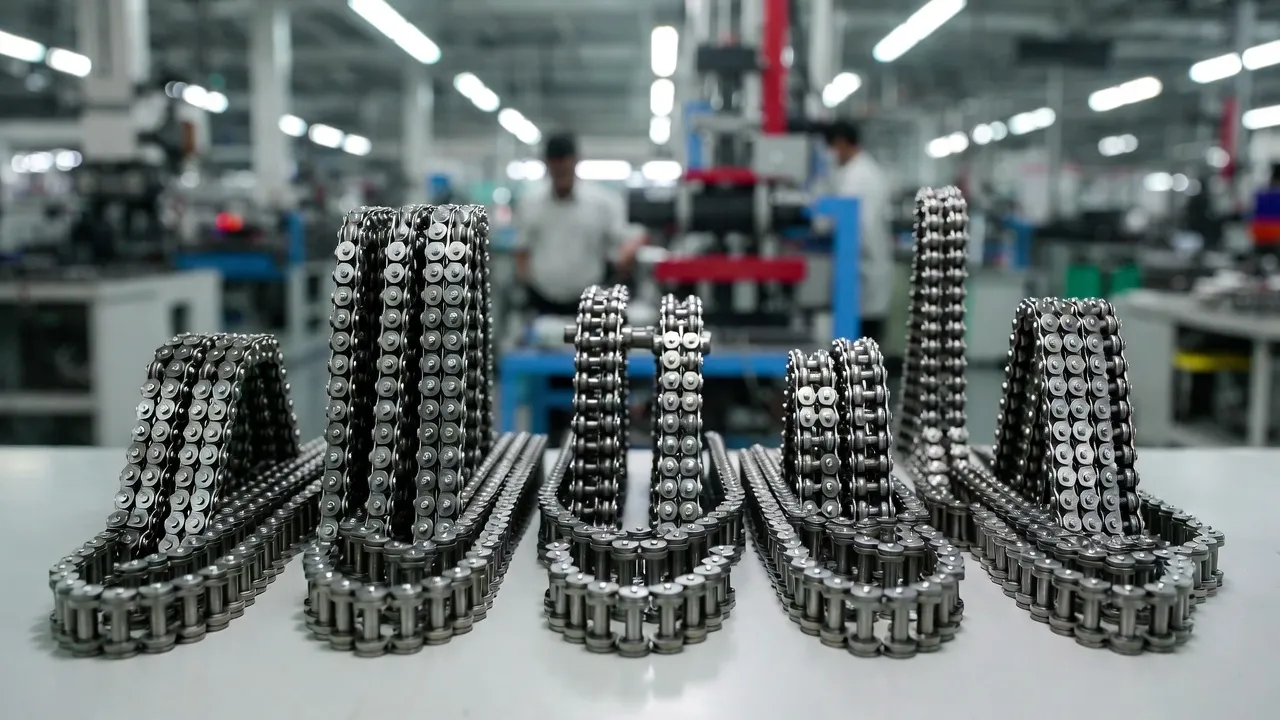
The Science Behind Self-Lubricating Simplex Chain Technology
Understanding how sintered-bush self-lubrication works — and what limits it — helps specifiers choose the right technology for each application and set realistic expectations for service life under specific operating conditions.
How It Works
1
Oil retention: The sintered bush contains interconnected pore networks (18–25% void fraction by volume) impregnated with ISO VG 68–100 mineral or PAO oil during manufacture.
2
Active lubrication: When the pin rotates in the bush under load, contact pressure forces oil from the pores to the bearing surface — the interface is flooded with oil precisely when and where it is needed.
3
Self-replenishment: On the relief stroke, when pin-bush contact pressure drops, capillary action draws oil back into the pores — resetting the lubrication reservoir for the next load cycle.
4
Depletion: Over thousands of operating hours, the oil volume in the pores gradually depletes. When the oil content drops below a critical level, the self-replenishment cycle weakens and wear accelerates — this marks the end of the maintenance-free service life.
Key Limitations
External oil accelerates depletion: Applying external oil to a sintered-bush chain displaces the internal oil from the pores by reducing surface tension, shortening the self-lubrication life. Never externally lubricate sintered-bush chains.
High-speed limits: At very high chain speeds (above 600 RPM for larger pitches), the pressure-time integral per articulation cycle is insufficient to force adequate oil to the bearing surface — conventional external lubrication becomes necessary above this threshold.
Temperature sensitivity: At high temperatures, oil viscosity drops below the level where capillary action can return oil to the pores effectively — above 100°C, oil migration accelerates and service life shortens. Specify PAO-based sintered-bush chains for elevated temperature applications within the 100°C limit.
Not truly zero-maintenance: “Maintenance-free” refers to lubrication only — the chain still requires periodic elongation measurement, alignment verification, and replacement at the 2% threshold regardless of the lubrication system.
Where Maintenance-Free Chains Deliver the Greatest Operational Value
Maintenance-free simplex chains deliver their strongest value proposition in applications where conventional external lubrication creates one or more of the following problems. Understanding these scenarios helps procurement teams justify the premium cost of maintenance-free specification.
🚧
Confined Space Regulations
Australian confined space regulations (AS 2865) require permit systems, atmospheric testing, standby persons, and rescue arrangements for every entry. On underground mining drives, tunnel conveyors, or pit-mounted drives, the cost of a lubrication entry can reach $500–$1,500 per event in safety management costs alone. Maintenance-free chains that require lubrication entries only once every 5,000–10,000 hours reduce annual confined space management costs by 80–90% on affected drives.
🍎
Food Safety Contamination Risk
In FSANZ-regulated food manufacturing environments, every external lubricant application creates a potential product contamination event. Maintenance-free stainless chains with sealed sintered-bush construction eliminate the lubricant application step entirely from the food zone — reducing both the contamination risk and the HACCP point of control associated with chain lubrication in food contact areas.
🌾
Remote Rural and Seasonal Equipment
Grain silos, on-farm auger systems, and remote irrigation pump stations across rural Australia are visited infrequently — often monthly or less. Conventional chain lubrication at the recommended 40-hour interval would require a lubrication visit every 2–3 operating days in continuous-use periods. Maintenance-free chains reduce the required visit frequency to alignment and elongation checks at 1,000-hour intervals — a fundamentally different maintenance commitment that suits remote site management.
💨
Dust and Contamination Environments
In grain handling, aggregate processing, and cement production environments, conventional chain oil creates a sticky outer surface that attracts and retains abrasive particles — turning each lubrication event into an abrasion accelerator. PTFE dry-film or sintered-bush maintenance-free chains avoid this particle adhesion problem entirely, maintaining a non-sticky chain surface that does not trap contaminants.
🤖
Automated Systems and Robots
Automated warehouses, robotic cells, and fully automated production systems have hundreds of chain drive positions that would require individual lubrication at prohibitive cost if maintained conventionally. Maintenance-free chains across all drive positions reduce the maintenance burden to periodic elongation checks and scheduled replacement — compatible with annual shutdown maintenance programmes rather than requiring continuous maintenance access to the running system.
Real-World Performance: Maintenance-Free Chains in Australian Operations
Underground Mining — Queensland Coal
A Queensland underground coal mine replaced standard carbon-steel chains with self-lubricating heavy-series simplex chains on 18 gateroad conveyor drives. Previous lubrication protocol required entry to confined drive zones every two weeks for manual chain oiling — each entry requiring a two-person confined space entry under the site’s coal mines safety management plan. The self-lubricating chains eliminated these lubrication entries, with maintenance limited to quarterly elongation checks during scheduled production shutdowns. Over an 18-month period, the annual confined space entry count for chain lubrication across the 18 drives fell from 468 to 72 — a reduction of 85%. Chain service life improved from an average of 11 months (standard chain with inconsistent lubrication access) to 22 months (self-lubricating chain with consistent internal lubrication). The total 5-year cost saving across all 18 drives was estimated at AUD $280,000, incorporating reduced safety management labour, lower replacement frequency, and eliminated chain failure events.
Food Processing — Victoria Dairy
A Victorian dairy processing facility replacing ageing standard SS304 chains on eight bottle-filling conveyor drives with SS316 sealed sintered-bush maintenance-free chains. The previous chains required H1-registered food-grade oil application at every production changeover (three times daily, seven days per week). In addition to the maintenance labour savings, the transition eliminated 312 annual food-zone lubricant application events — each a potential contamination event under the facility’s HACCP plan. The HACCP audit burden for chain lubrication was eliminated as a critical control point, reducing the facility’s documented CCP count and the associated monitoring and record-keeping requirements. The maintenance-free chains achieved 8,200 hours before reaching the 2% elongation replacement threshold — representing 14 months of continuous three-shift operation in a high-wash-down environment where conventional chains had previously lasted 7–9 months.
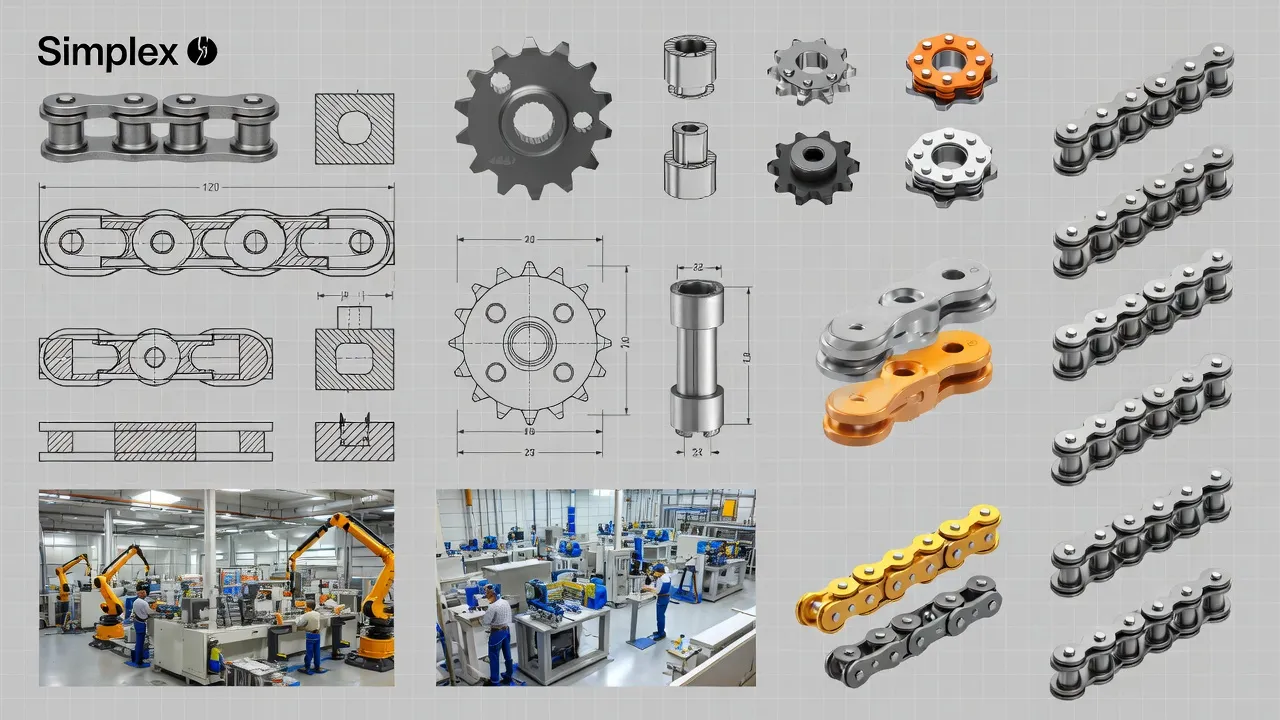
Selecting the Right Maintenance-Free Technology for Your Application
The correct maintenance-free technology depends on the specific problem being solved. The following decision process systematically matches application conditions to the appropriate maintenance-free chain specification.
🌡️Temperature > 100°C?
→ PTFE dry-film or ceramic bushed. Above 100°C, sintered-bush oil migration rates are too high for reliable self-replenishment. PTFE remains effective to 260°C. Ceramic bushings operate dry to 600°C. Confirm the specific operating temperature before specifying.
🍎Food Contact Zone?
→ SS316 or SS304 sealed sintered-bush. Stainless body for corrosion resistance and regulatory compliance. Sintered-bush eliminates lubricant application from the food zone. Confirm material meets FSANZ food contact requirements for the specific food category.
💨Dusty or Abrasive Environment?
→ PTFE dry-film or sintered-bush without external oil. The non-sticky chain surface prevents particle adhesion. Critical: never apply external oil to chains in dusty environments — it creates the particle adhesion problem that maintenance-free chain is designed to prevent.
🚧Confined Space Access?
→ Sintered-bush self-lubricating chain (any material). Select the material grade appropriate for the operating environment — carbon steel for most mining applications, stainless for corrosive mining environments, zinc-nickel plated for coastal mine sites. Verify temperature is within the sintered-bush operating range.
🌾Remote / Infrequent Access?
→ Sintered-bush self-lubricating chain. Target applications where the maintenance visit frequency makes conventional lubrication impractical. Size the chain to achieve the target lubrication-free interval of 5,000–10,000 hours, aligning with the site’s planned inspection visits.
🤖High-Cycle Automated System?
→ Sintered-bush at standard speed ranges, PTFE dry-film for clean-room or no-contamination environments. Confirm the operating speed is within the sintered-bush’s self-replenishment capability. For high-speed automated drives above 600 RPM, evaluate whether centralised auto-lube is more appropriate than maintenance-free chain.
Cost Justification: Maintenance-Free Chain vs Conventional Chain
The purchase price premium of maintenance-free chains — typically 40–80% above equivalent standard chain — is recovered through the avoided costs of conventional lubrication over the chain’s service life. The following comparison uses conservative Australian field values.
| Cost Component |
Conventional Chain (per year) |
Maintenance-Free Chain (per year) |
| Lubrication labour (26 fortnightly visits × 20 min × $95/hr) |
$822 |
$0 |
| Confined space safety management (if applicable, 26 entries × $800) |
$20,800 |
$0 |
| Lubricant cost (1 L/year × $25/L) |
$25 |
$0 |
| Chain replacement (more frequent due to variable lube access) |
$350/year (14-month avg life) |
$220/year (22-month avg life, 60% premium chain cost) |
| Total annual cost (without confined space compliance) |
$1,197 |
$220 |
| Total annual cost (with confined space compliance) |
$21,997 |
$220 |
For applications without confined space compliance costs, the simple maintenance-free premium pays back in reduced lubrication labour within 12–18 months. For confined space applications, the payback occurs within weeks of installation. The critical input to any site-specific justification is the actual confined space compliance cost per entry — which varies significantly between sites and between states.
To evaluate the maintenance-free chain cost justification for your specific application — including site-specific labour rates, visit frequencies, and compliance cost inputs — contact the technical team at Gear Drive Australia.
Speak with our maintenance-free chain specialists at Gear Drive Australia for an application review, cost-benefit analysis, and specification recommendation for maintenance-free simplex chains across Australian industrial, mining, and food processing operations.
Frequently Asked Questions
What does “maintenance-free” actually mean for a simplex chain? +
In the simplex chain context, “maintenance-free” refers specifically to the elimination of external lubrication requirements — the chain provides its own boundary lubrication internally through sintered-bush oil reservoirs, PTFE dry-film coatings, or sealed grease packs, without requiring manual or automated external oil application throughout the chain’s service life. The term does not mean the chain requires no maintenance at all. Periodic elongation measurement (every 500–1,000 hours depending on application severity), alignment verification, and eventual replacement when elongation reaches 2% are still required maintenance activities. The value of maintenance-free specification is the elimination of the most frequent maintenance task — lubrication — and the elimination of the contamination, safety, and access risks that routine lubrication creates in demanding Australian industrial environments.
How long does a self-lubricating simplex chain last before replacement? +
Service life of self-lubricating simplex chains — measured to the 2% elongation replacement threshold — varies with the operating conditions. In clean, moderate-speed (200–500 RPM) industrial drives at ambient temperature, premium sintered-bush chains typically achieve 8,000–12,000 hours. In dusty environments where the chain’s non-sticky surface prevents particle adhesion, 6,000–10,000 hours is achievable with self-lubricating chains versus 3,000–6,000 hours for conventional chains with inadequate lubrication in the same environment. In remote agricultural applications with intermittent operation and seasonal storage, calendar-based planning is less reliable than hour-based wear-rate trending — the lubrication-free interval is defined by operating hours, not storage time, so the chain may remain serviceable for multiple seasons if the total operating hours are low. Replace on elongation measurement data, not estimated service hours, for the most accurate replacement timing.
Can I use maintenance-free chain for a heavy-load application? +
Yes — self-lubricating sintered-bush chains are available in heavy-series (H) configurations that combine the internal lubrication benefit with the increased plate thickness of heavy-series chain for shock-load applications. The capacity reduction (5–10% versus standard chains at equivalent grade) is managed by selecting the heavy-series self-lubricating chain one pitch size larger than the standard chain that would be specified for the same application. In heavy shock applications where conventional lubrication access is constrained by confined space regulations or remote location, the combination of heavy-series self-lubricating chain with a service factor of 1.7–2.0 provides both the fatigue life needed for the shock loading and the maintenance-free lubrication benefit that makes the drive practically manageable. The ceramic-bushed variant for very high-temperature heavy-duty applications does carry a larger capacity reduction (20–30%) and requires careful sizing — consult Gear Drive’s engineering team before specifying ceramic-bushed chains for high-load applications.
Why shouldn’t I add external oil to a self-lubricating chain? +
External oil application on a sintered-bush self-lubricating chain interferes with the capillary action that draws oil back into the pores after each load cycle. When external oil floods the chain surface, it disrupts the surface tension gradient between the pore network and the external surface — oil migrates outward from the pores rather than being retained internally, accelerating depletion of the internal reservoir. Additionally, in dusty environments, external oil creates a sticky outer surface that attracts and retains abrasive particles — the exact problem the maintenance-free chain was specified to avoid. The correct approach is to leave self-lubricating chains completely free of external lubricant throughout their service life, allowing the internal sintered-bush system to operate as designed. The only exception is at initial installation: some manufacturers recommend a single application of the specified oil grade to the pin-bush interface before commissioning, to supplement the factory-applied oil charge during the run-in period. After this initial application, no further external lubrication is required or beneficial.
What is the difference between O-ring and X-ring sealed chains? +
Both O-ring and X-ring sealed chains use elastomeric seals to retain grease within the pin-bush interface, preventing contamination ingress and eliminating the need for external lubrication. The distinction lies in seal geometry and friction. An O-ring seal uses a circular cross-section elastomer that creates two contact points (inner and outer diameter) when compressed between the link plate and bush end face. An X-ring (also called Z-ring or quadrilateral seal) uses a four-lobed cross-section that creates four contact points at a lower contact pressure for equivalent sealing performance. The lower contact pressure of the X-ring reduces the friction penalty of the seal compared with O-ring — approximately 50% lower seal friction — which translates into better efficiency at equivalent load and speed. In industrial simplex chain applications, sealed chains are less commonly used than sintered-bush chains because sealed chain grease cannot be replenished without seal removal, whereas sintered-bush chains can theoretically be recharged in a pressure oil bath. For light-to-moderate load applications where maximum service life with minimal friction loss is the priority, X-ring sealed chains are the superior choice between the two sealed types.
Are maintenance-free chains suitable for food processing in Australia? +
Yes — maintenance-free stainless simplex chains are the preferred specification for food processing chain drives in FSANZ-regulated Australian facilities, for two reasons. First, the absence of external lubricant application eliminates a potential food contamination event at every lubrication visit. Second, stainless construction (SS316 for wash-down environments, SS304 for non-direct-contact positions) withstands the caustic and acidic cleaning agents used in food production hygiene programmes without the corrosion risk that carbon-steel chains would face. The sintered-bush technology uses oil that is impregnated during manufacturing and retained internally — it never migrates to the chain outer surface in contact with food products under normal operating conditions. However, the food-grade specification requires additional confirmation: the factory-applied lubricant must be NSF H1 registered (incidental food contact acceptable), and all component materials must comply with applicable food contact regulations under FSANZ Standard 1.5.2 and any state food safety legislation. Request explicit food-grade compliance confirmation from the supplier before specifying maintenance-free chains in any food contact zone.
How do I know when a maintenance-free chain needs replacement? +
The replacement criterion for maintenance-free simplex chains is identical to standard chains: replace at 2% elongation, measured as the 30-link span exceeding the nominal new-chain dimension by 2%. The absence of external lubrication does not change this criterion or the measurement method. The key difference in managing maintenance-free chain replacement is that the approaching end of the sintered-bush lubrication period — typically signalled by a slight increase in the chain’s operating noise level and a marginal increase in the elongation wear rate — may occur before the 2% elongation threshold is reached. When this transition is detected by an increase in measured wear rate above the expected value, the chain should be replaced at the next planned shutdown regardless of the elongation measurement. If elongation trending shows the wear rate accelerating (rate increasing between consecutive measurements), the internal oil reservoir is depleting and the chain is entering its accelerated wear phase — plan replacement within the next 500–1,000 operating hours rather than projecting forward at the previous wear rate, which will underestimate remaining life.
Can I retrofit self-lubricating chain to an existing standard-chain drive? +
Yes — self-lubricating chains use the same pitch, roller diameter, and overall dimensions as standard chains at the same designation. A retrofit requires no drive geometry changes, no sprocket replacement (unless hook wear is present and would accelerate the new chain’s wear — inspect sprockets before fitting any new chain), and no lubrication system removal. The only change to the maintenance routine after retrofit is the elimination of the lubrication schedule entries for the drive — and confirmation that any existing drip oiler or bath system is decommissioned or bypassed, as continued lubrication application would counteract the self-lubricating mechanism. Before retrofitting, verify that the chain speed at the drive position is within the self-lubricating chain’s rated speed range for the selected pitch — drives operating above 600 RPM on larger pitches may exceed the effective self-replenishment threshold. The retrofit is the most common introduction of maintenance-free chains in Australian operations — the performance comparison between the previous conventional chain and the retrofit self-lubricating chain, tracked through elongation trending, provides the data to justify similar upgrades across other drives at the site.
What is the cost premium for maintenance-free chains and when does it pay back? +
The purchase price premium for sintered-bush self-lubricating simplex chains is typically 40–70% above equivalent standard chains at the same pitch and series. PTFE dry-film chains carry a 60–90% premium. SS316 sealed sintered-bush chains carry 100–150% premium due to the stainless material cost. The payback period depends entirely on what the alternative maintenance cost is. For standard industrial drives accessed without confined space complications, the premium on a single chain replacement event is modest (perhaps $50–$150 additional cost) and the payback comes from reduced lubrication labour over 1–2 years. For confined space drives where each lubrication entry costs $500–$1,500 in safety management, the premium pays back within the first 1–3 lubrication events it prevents — often within the first month of operation. For remote agricultural drives where the lubrication visit cost includes travel, the premium often pays back within the first season’s avoided visits. The universal observation from Australian operations that have implemented maintenance-free chain on lubrication-access-constrained drives is that the total lifecycle cost — not just the chain cost — is consistently lower than the conventional alternative, regardless of the purchase price premium.
