Technical Reference: Custom Simplex Chain Configurations and Parameters
Custom simplex chain manufacturing begins with a precise engineering brief that documents every parameter affecting chain performance and interchangeability. The table below shows the customisable variables available in standard and modified simplex chain manufacturing, along with the standard reference values that serve as a baseline for custom deviation.
| Parameter |
Standard Range |
Custom Capability |
Why Customised |
Lead Time Impact |
| Pitch |
9.525–76.2 mm (ISO/ANSI) |
Non-standard pitches possible |
Legacy OEM equipment with unusual pitch |
+6–10 weeks |
| Material |
Carbon steel, SS304, SS316 |
Duplex SS, Hastelloy, titanium |
Highly corrosive chemical environments |
+8–14 weeks |
| Surface treatment |
Zinc-Ni plate, nickel plate |
PTFE coat, electroless nickel, PVD |
Dry-run capability, extreme corrosion |
+3–5 weeks |
| Plate thickness |
Standard or Heavy (+20%) |
Intermediate or extra-heavy thickness |
Cyclic fatigue beyond standard H-series |
+4–8 weeks |
| Attachment configuration |
K1, K2 standard positions |
Custom attachment geometry, any position |
Bespoke conveyor carrier design |
+4–8 weeks |
| Bush type |
Solid steel or sintered |
Ceramic, PTFE-composite, bronze |
High temperature, chemical resistance |
+6–10 weeks |
| Circuit length |
Any even number of pitches |
Cut and joined to exact pitch count |
Fixed-centre drives with no takeup |
+1–3 days (standard sizes) |
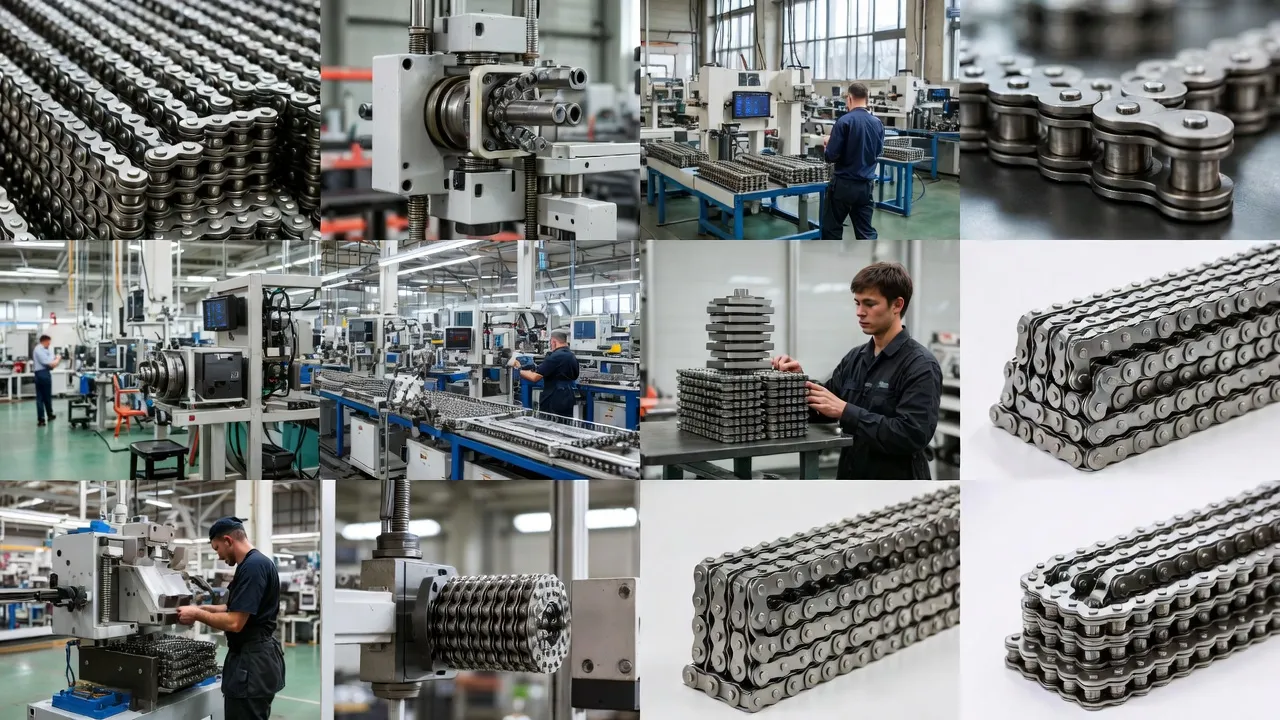
When Standard Simplex Chain Specifications Fall Short
The vast majority of Australian industrial chain applications are served by standard catalogue simplex chains — and this is intentional, because standard chains are less expensive, immediately available, and engineered to handle the power and environmental conditions of typical industrial drives. Custom chains become necessary when one or more of the following conditions push the application outside the standard range.
⚠️
Legacy Equipment with Non-Standard Pitch
Older Australian mining, processing, and paper mill equipment — much of it installed before metrication — uses imperial-derived pitches that do not map directly to ISO or ANSI catalogue chains. Pitches such as 1-¼”, 1-½”, or 2″ are no longer standard but still in service on equipment that cannot be economically redesigned. Custom chain manufacturing to these legacy pitches extends the operating life of functional equipment without a costly machine rebuild.
🌡️
Extreme Temperature Environments
Standard simplex chains with steel bushings and mineral oil lubrication have an effective operating range of approximately −20°C to +150°C. Beyond this range, standard component materials begin to fail — oils carbonise at high temperature, standard bushings lose dimensional stability at cryogenic temperatures, and standard plate steels lose impact toughness below −40°C. Ceramic-bushed, PTFE-lubricated chains for furnace conveyors, or cryogenic-grade stainless chains for liquid nitrogen handling, require non-standard material combinations unavailable in catalogue ranges.
⚗️
Aggressive Chemical Environments
Standard SS304 and SS316 chains cover most corrosive environments in Australian chemical and pharmaceutical processing. However, halide acid environments (hydrochloric acid, hydrofluoric acid), strong oxidising acids at elevated temperature, and concentrated alkali solutions can attack even 316 stainless over extended operating periods. Duplex stainless (2205), Hastelloy C-276, or PTFE-encapsulated chain components are specified for these environments, typically requiring custom manufacturing because these exotic alloys are not maintained in standard catalogue stock.
🔧
Bespoke Conveyor Carrier Design
Industrial product carriers, hangers, and pushers in custom conveyor systems often require attachment plate geometries that differ from the standard K1/K2 configurations. Custom attachment plates — welded or bolted to the outer link at client-specified dimensions and positions — allow the chain to interface directly with proprietary carrier hardware without requiring adapter plates that introduce additional failure points and dimensional variability into the conveyor system.
💪
Ultra-High-Cycle Fatigue Applications
Certain manufacturing drives — newspaper press chains, high-speed assembly conveyors, precision indexing systems — accumulate fatigue cycles far beyond what standard chains experience in typical industrial service. Custom-manufactured chains with extra-heavy plates, vacuum-degassed plate steel for minimum inclusion content, and double-shot-peening treatment are specified when the target service life exceeds what the heavy-series standard chain can deliver under the actual cycle count of the application.

The Custom Simplex Chain Manufacturing Process
Custom simplex chain manufacturing follows a structured process from application brief to delivered component. Understanding the stages helps procurement teams plan lead times and prepare the technical information needed at each step.
1
📋 Application Brief Submission
The client provides: drive power (kW), driver sprocket RPM, desired velocity ratio, centre distance, daily operating hours, environmental conditions (temperature, chemicals, humidity), any existing dimensional constraints, and the reason standard chain cannot be used. This brief enables the engineering team to confirm whether customisation is genuinely needed or whether a standard catalogue solution exists.
2
⚙️ Engineering Design and Costing
The chain engineering team develops a specification drawing covering all critical dimensions, tolerances, material standards, heat treatment requirements, surface treatment, and connecting link configuration. A formal cost proposal is prepared covering tooling (if non-standard pitches require new tooling), material cost for the specified alloy, manufacturing lead time, and quality documentation scope.
3
✅ Drawing Approval and Order Confirmation
The client reviews and approves the engineering drawing, confirming dimensional requirements and material specification before production begins. This approval stage catches interpretation errors that could result in a chain that meets the drawing but not the application — critical for expensive exotic-alloy orders where re-manufacture cost is significant.
Production proceeds against the approved drawing under the manufacturer’s ISO 9001 quality management system. Inspection points include material certification, dimensional checks at each assembly stage, hardness testing on heat-treated components, tensile testing on representative links from the production run, and final chain elongation measurement to confirm as-manufactured pitch accuracy.
5
📦 Documentation and Delivery
The completed chain is delivered with a full documentation pack: production drawing, material mill certificates, heat treatment records, dimensional inspection report, tensile test certificate, and surface treatment confirmation. This documentation supports the client’s engineering records, incoming inspection, and any future re-order without requiring a new engineering cycle.
6
🔁 Re-Order and Supply Programme
Once the chain design is proven in service, a permanent part number is assigned against the approved drawing. Re-orders are placed against this number, referencing the original documentation. Forward supply agreements with minimum order quantities reduce re-order lead times significantly — often to 60–80% of the original custom manufacturing lead time once tooling and materials are pre-positioned.
Custom Simplex Chain Applications Across Australian Industry
Mining Sector: Heavy-Pitch Chains for Extreme Loads
Western Australian iron ore and Queensland coal mining operations run chain conveyor drives at pitches above the standard ISO catalogue range — 50.8 mm through 101.6 mm — and at tensions that exceed the rated capacity of standard chains at those pitches. Custom manufacturing for these applications typically combines a larger-than-catalogue plate thickness with high-alloy steel to achieve the fatigue life required under continuous 24-hour operation at high shock loading from ore surges. Custom corrosion protection is also common — anti-static zinc-nickel plated chains for classified underground atmospheres, or hot-dip zinc coated chains for outdoor belt-structure chain drives exposed to cyclonic-season rain events in the Pilbara and Bowen Basin regions.
Timber and Paper Processing: High-Temperature Kiln Chains
Timber drying kilns and paper mill dryer sections operate at temperatures of 120–180°C in atmospheres that combine heat with acidic condensate from the wood or paper drying process. Standard chain lubricants oxidise to carbon deposits within days at these temperatures, creating a dry, grit-contaminated interface that generates rapid abrasive wear. Custom chains for these applications use ceramic-bushed construction — alumina or silicon carbide ceramic bushings that operate without lubrication at temperatures where oils are ineffective — combined with high-temperature alloy steel plates capable of maintaining fatigue strength above 150°C. These chains are among the most technically demanding custom simplex chain products manufactured for Australian industry, requiring ceramic component quality control and high-temperature tensile testing that standard chain quality systems do not address.

Food and Pharmaceutical: Zero-Contamination Chain Assemblies
High-care food production and pharmaceutical manufacturing facilities specify chain assemblies in which every component is traceable to food-grade or pharmaceutical-grade material certifications. This goes beyond standard SS304/SS316 stainless specification to include positive confirmation that no prohibited substances are present in the base metal, that surface treatments use only approved compounds, and that connecting links and master links are manufactured from the same material grade as the chain body. Custom chain assemblies for these environments include full material traceability from mill certificate through component manufacturing to the assembled chain, with batch-level documentation retained for 10-year periods as required by pharmaceutical GMP regulations applicable to Australian therapeutic goods manufacturing.
How to Specify a Custom Simplex Chain: Information Required
Providing a complete specification brief reduces the number of clarification rounds and shortens the time from enquiry to design approval. The following checklist covers the information that custom chain engineering teams require before proceeding with design work.
- Transmitted power (kW)
- Driver sprocket RPM
- Velocity ratio required
- Daily operating hours
- Load type (smooth / shock)
- Service factor applied
📐
Dimensional Requirements
- Pitch (if non-standard, why)
- Maximum chain width constraint
- Circuit length (pitches or mm)
- Connecting link type required
- Attachment geometry (drawing)
- Sprocket standard (ISO or ANSI)
🌍
Environmental Conditions
- Operating temperature range
- Chemical exposure (specify)
- Moisture / humidity level
- Abrasive particle presence
- Classified atmosphere (ATEX/IECEx)?
- Food contact / pharmaceutical zone?
- Required certifications (ISO 9001, etc.)
- Material traceability depth needed
- Tensile test requirements
- Hardness test requirements
- Surface treatment certification
- Drawing approval requirements
Understanding Custom Chain Cost and Lead Time
Custom simplex chain commands a premium over catalogue product — but the cost premium is frequently misunderstood because it is compared against catalogue chain unit price rather than against the total cost of the problem it solves. A custom chain at 3× the catalogue unit price is cost-effective if it eliminates a quarterly $8,000 downtime event on equipment that catalogue chain cannot serve reliably.
| Customisation Type |
Cost Premium (vs catalogue) |
Typical MOQ |
Lead Time (first order) |
Re-order Lead Time |
| Cut-to-length (standard size) |
+5–10% |
1 circuit |
3–7 days |
3–5 days |
| Standard size + special surface treatment |
+20–50% |
3–5 metres |
3–5 weeks |
2–4 weeks |
| Standard size + custom attachments |
+30–80% |
5–10 metres |
4–8 weeks |
3–5 weeks |
| Non-standard pitch (catalogue tooling) |
+50–150% |
10–20 metres |
6–12 weeks |
4–6 weeks |
| Exotic alloy (Hastelloy, duplex SS) |
+200–500% |
10+ metres |
10–18 weeks |
8–12 weeks |
| Ceramic-bushed high-temperature |
+300–600% |
5+ metres |
12–20 weeks |
8–14 weeks |
Planning Tip: For applications requiring custom chain, order the first batch with a 20–30% quantity buffer above immediate requirements. This buffer provides an on-site spare while the re-order lead time is being processed, and also provides sample links for destructive testing if any installation or performance questions arise after commissioning. The cost of the buffer stock is consistently lower than the emergency freight and expediting cost of an urgent re-order if the installed chain fails before the re-order arrives.

Custom Simplex Chain Solutions Through Gear Drive Australia
Gear Drive Australia provides custom simplex chain solutions for Australian industrial clients through a structured engineering process that begins with application review and ends with documented, certified chain assemblies matched precisely to the drive requirements. Our custom chain capability covers the full range from simple cut-to-length service on standard catalogue chains through to fully bespoke exotic-alloy assemblies for the most technically demanding operating environments in Australian industry.
🔬
Application Engineering Review
Our engineers review the application brief before quoting — confirming that custom chain is genuinely needed and that the proposed specification will perform as required. This review prevents costly custom orders that could be served by catalogue product, or custom orders where the specification is technically inadequate for the stated conditions.
📐
Detailed Engineering Drawings
Every custom chain order is supported by a formal engineering drawing showing all dimensions with tolerances, material specifications, surface treatment requirements, and connecting link configuration. The drawing becomes the permanent specification reference for all future re-orders.
📄
Full Certification Package
Delivered documentation covers material mill certificates, heat treatment records, dimensional inspection reports, tensile test certificate, and surface treatment confirmation. We maintain electronic records of all custom chain orders for 10 years to support warranty claims, incident investigations, and re-order documentation.
Explore standard and custom simplex chain options at Gear Drive Australia’s chain engineering resource centre — or submit your custom chain requirement brief directly to our technical team for a preliminary engineering assessment at no charge.
Contact our custom chain engineering specialists at Gear Drive Australia — we provide obligation-free preliminary engineering assessments for custom simplex chain requirements across mining, processing, food manufacturing, chemical, and automation sectors.
Frequently Asked Questions
What information do I need to provide to get a custom simplex chain quote? +
To receive an accurate custom chain quote, provide the following: drive power in kW, driver sprocket RPM, velocity ratio required, centre distance between shaft centres, load character (smooth, moderate shock, or heavy shock), daily operating hours and days per year, operating temperature range, any chemical or corrosive substance the chain will be exposed to, required chain pitch if known (or description of why a standard pitch cannot be used), any dimensional constraints on chain width or outer plate height, attachment configuration requirements (including a sketch or drawing if custom attachments are involved), required certifications, and the quantity required for the initial order plus the estimated annual usage. Providing existing chain samples or a chain manufacturer’s part number from the current installation (if replacing a non-catalogue chain) significantly reduces the engineering assessment time and improves quotation accuracy.
Can custom simplex chains be made in small quantities? +
Minimum order quantities for custom simplex chains depend on the type and degree of customisation. For cut-to-length service on standard catalogue chains, minimum orders can be as small as a single circuit. For standard chains with special surface treatments (PTFE coating, electroless nickel, exotic plating), minimum orders are typically 3–10 metres to justify the treatment batch setup cost. For non-standard pitch chains, minimum orders are usually 10–20 metres due to the tool setup cost amortised across the batch. For exotic alloy chains in very small quantities, setup costs are disproportionately high — some manufacturers have a minimum order equivalent to $2,000–$5,000 AUD in chain material to justify production setup. If your requirement is a genuinely small quantity of an exotic specification, discuss this upfront with the engineering team — in some cases, an alternative standard specification that can be served in small quantities may perform equally well in the application, avoiding the custom minimum quantity constraint.
How long does it take to manufacture a custom simplex chain? +
Manufacturing lead time varies significantly with the complexity of the customisation. Standard chains cut to length and fitted with specific connecting links are typically available within 3–7 business days for stocked sizes. Standard chains with special surface treatments require 3–5 weeks for the treatment process plus shipping. Standard pitch chains with custom attachments welded or machined require 4–8 weeks for attachment fabrication plus chain assembly. Non-standard pitch chains require 6–12 weeks when existing tooling can be adapted, or 14–20 weeks when new tooling must be manufactured. Exotic alloy chains (Hastelloy, duplex stainless) require 10–18 weeks due to the extended lead time on specialty material procurement in Australia — and the need to import materials that are not routinely stocked in local distribution. Ceramic-bushed high-temperature chains are among the longest lead time custom products at 12–20 weeks due to the ceramic component manufacturing and quality control stages. For all custom chain orders, plan to include buffer stock in the first order to cover the re-order lead time for future replacements.
Can I get a custom chain made to match an existing obsolete chain? +
Yes — reverse-engineering from an existing chain sample is a standard service for obsolete or legacy equipment chains. If you can provide a sample of the existing chain (minimum 500 mm for accurate pitch measurement; 1,000 mm preferred), the engineering team can measure all critical dimensions and replicate the chain to a new engineering drawing. Key measurements taken from the sample include: pitch (measured across multiple consecutive links for accuracy), inner width, roller diameter, bush outer diameter, pin diameter and length, plate thickness, plate height, and attachment configuration if present. Where the existing chain uses a non-standard pitch or unusual material, the sample dimensions form the basis of a new custom specification. The quality of the replicated chain will typically exceed the original if the original was manufactured to a lower standard — an incidental benefit of custom replication that extends service life on equipment that previously experienced rapid chain wear.
What surface treatments are available for custom simplex chains? +
Custom simplex chains can be specified with a range of surface treatments beyond the standard bright zinc-nickel electroplate available on catalogue chains. Electroless nickel plating provides a uniform, dimensionally precise coating with good corrosion and wear resistance, suited to chains where tight dimensional tolerances must be maintained after treatment. PTFE dry-film coating deposited on the chain surface provides a low-friction, particle-repellent outer surface that reduces particle adhesion in dusty environments without requiring a separate lubricant application. PVD (Physical Vapour Deposition) titanium nitride or chromium nitride coatings provide exceptional surface hardness (HV 1500–2500) combined with low friction — specified for chains in abrasive dry-run environments where conventional lubricants cannot be used. Black oxide treatment provides modest corrosion resistance improvement and a distinctive appearance, commonly specified for visible chains in retail display or architectural applications. Passivation (citric acid or nitric acid treatment) of stainless chains improves the chromium oxide passive layer, enhancing corrosion resistance in chloride environments — important for SS304 chains at the borderline of their chloride tolerance. Each treatment carries specific lead time and minimum quantity implications that should be discussed with the engineering team before specification.
Are custom simplex chains more expensive to maintain than standard chains? +
In most cases, custom simplex chains are not more expensive to maintain — they are simply maintained using the same inspection, lubrication, and replacement procedures as standard chains, adapted for the specific environment they serve. The elongation measurement method is identical regardless of material or surface treatment; the replacement threshold (2% elongation) applies universally; and the lubrication method is dictated by the operating speed and environment, not by whether the chain is custom or standard. The maintenance cost difference lies in the replacement chain cost and lead time, which are higher for custom chains — but this is a procurement cost rather than a maintenance labour cost. For custom chains in critical applications, maintaining a larger on-site spare inventory (typically one full circuit in stock at all times rather than relying on re-order) is the primary maintenance planning difference versus standard chains. The carrying cost of this larger inventory is proportional to the custom chain unit cost premium, which is itself proportional to the severity of the application demanding custom specification — in most cases the inventory cost is small compared with the operational risk it mitigates.
Can I specify a custom chain to handle a higher shock load than the heavy-series catalogue allows? +
Yes — custom chain manufacturing can produce plates beyond the heavy-series (H) thickness available in the catalogue. Extra-heavy-series plates at 130–150% of standard plate thickness are produced for applications where even the catalogue heavy-series chain fails to achieve the required fatigue life under extreme cyclic shock loading. These specifications are used in applications such as newspaper press chains operating at 5+ million cycles per day, mining equipment starting under full load multiple times per shift, and ultra-high-duty press drives where the chain is the last line of overload protection before the press frame or tooling would be damaged. Custom extra-heavy-series chains are typically manufactured to a client-specific drawing rather than a catalogue designation and require individual tensile certification for each production batch. The engineering review for these specifications verifies that the selected plate dimensions produce the required fatigue limit increase and that the connecting link can be manufactured to match the increased plate strength — spring-clip links are never appropriate at this load level, and custom press-fit links with matching interference tolerances are specified as part of the chain assembly.
How do I know if my application truly needs custom chain or if a standard specification will work? +
The decision between custom and catalogue chain is most reliably made by an engineering assessment that evaluates the application parameters against the full range of standard catalogue options — not just the commonly stocked sizes. Many applications that arrive as custom enquiries can be served by catalogue products that are less commonly specified but fully available, such as heavy-series variants, stainless grades in larger pitches, or self-lubricating chains in sizes beyond the standard display stock. Genuine custom need arises when: (1) the required pitch is not listed in any current ISO or ANSI catalogue; (2) the required material combination (alloy + surface treatment + bush material) is not available in any catalogue specification; (3) the attachment geometry required cannot be achieved through standard K1/K2 attachment variants; or (4) the required circuit length produces an odd number of pitches that cannot be accommodated without an offset link, and the drive geometry cannot be adjusted to use an even-pitch circuit. Submitting a brief application description to the Gear Drive Australia engineering team costs nothing and takes less than 15 minutes — our first response will confirm whether a catalogue solution exists or whether custom manufacturing is genuinely required, saving the time and cost of pursuing a custom order that was not necessary.
What testing is performed on custom simplex chains before delivery? +
Custom simplex chains undergo a more extensive test programme than standard catalogue products to confirm that the custom specification has been achieved in manufacturing. The standard custom chain test programme includes: dimensional inspection against the approved drawing, with measurements at multiple points across the chain circuit to confirm pitch consistency; hardness testing on heat-treated components (pins, bushings) to verify that the specified surface and core hardness values have been achieved; tensile testing of representative links to confirm that the minimum breaking load meets or exceeds the specified value; surface treatment thickness and adhesion testing (where surface treatments are specified); and final visual inspection for surface defects, connection correctness, and lubrication application. For exotic alloy chains, a positive material identification (PMI) test using XRF spectroscopy confirms that the delivered alloy matches the specified chemistry — critical for Hastelloy and duplex stainless specifications where material substitution risk is significant. The test results are compiled into the documentation package delivered with the chain and retained in the supplier’s quality records for the agreed retention period.
Can I get custom simplex chains that comply with Australian mining safety regulations? +
Yes — custom simplex chains can be specified and certified to meet the requirements of Australian state and territory mining safety legislation. For Western Australian underground metalliferous mining, chains used in classified zones must comply with relevant requirements of the Mines Safety and Inspection Act and associated regulations. For Queensland underground coal mining, AS 2380 anti-static requirements apply to chain components operating in potentially explosive atmospheres — custom anti-static chains use copper-beryllium or stainless components to eliminate ignition risk from friction sparks. For South Australian and New South Wales mining operations, compliance with site-specific safety management plans may impose chain certification requirements beyond the standard tensile test certificate. When specifying custom chains for Australian mining applications, provide the state, mine classification (metalliferous or coal), atmospheric classification (ATEX/IECEx zone), and any existing site safety management plan requirements that govern drive component certification. This information allows the engineering team to include the appropriate compliance documentation and material/treatment selections in the custom specification from the outset, rather than discovering compliance gaps after the chain has been manufactured.
