Technical Specifications: Automation and Material Handling Simplex Chains
Automated systems and material handling equipment impose drive requirements that differ in important ways from conventional machinery — precision positioning, continuous duty cycles, hygiene requirements in food and pharmaceutical handling, and the need for high drive reliability when a single chain stop can halt an entire automated line. The table below maps common automation chain applications to their key engineering parameters.
| Automation Application |
Chain Spec |
Pitch (mm) |
Speed Range |
Precision Req. |
Material |
Key Requirement |
| Robotic cell indexing |
06B-1 / 08B-1 |
9.5–12.7 |
300–800 RPM |
±0.3 mm |
Alloy / SS304 |
Low backlash, high tooth count |
| AGV drive units |
08B-1 / 10B-1 |
12.7–15.9 |
50–300 RPM |
Speed accuracy |
Alloy sealed |
Maintenance-free, sealed joints |
| Pallet conveyor systems |
12B-1 / ANSI 60 |
19.05 |
100–300 RPM |
Sync across lanes |
Alloy steel |
Consistent pitch, low elongation |
| Overhead power-and-free |
Extended pitch conveyor |
38.1–101.6 |
5–60 RPM |
Load position |
Attachment chain |
Attachments at defined pitch intervals |
| Automated warehouse retrieval |
08B-1 SL / 10B-1 SL |
12.7–15.9 |
200–600 RPM |
Position repeat |
Self-lubricating |
Zero external lube, clean facility |
| Food automation lines |
06B-1 / 08B-1 SS |
9.5–12.7 |
300–600 RPM |
Fill accuracy |
SS304/316 sealed |
FSANZ compliance, wash-down safe |
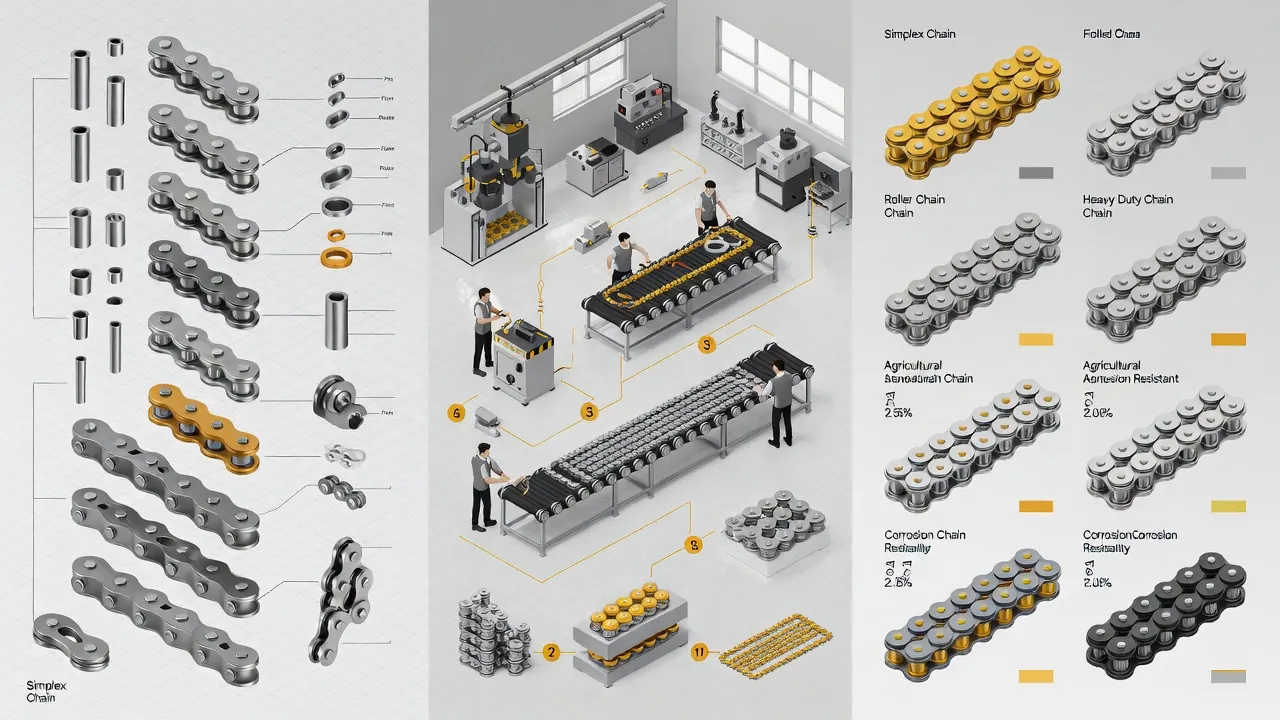
Why Simplex Chain Is the Preferred Drive for Automated Systems
Automation engineers face a narrow set of acceptable drive solutions when designing material handling systems that must operate reliably for years with minimal intervention. Simplex chain earns its position on the specification sheet through five properties that automated systems demand specifically.
🎯
Absolute Positional Accuracy
Automated systems — pick-and-place cells, vision inspection stations, labelling heads — require drive elements that deliver the same position at each cycle. Simplex chain’s positive engagement with sprocket teeth maintains cyclic positional accuracy within ±0.5 tooth pitch throughout its service life, until elongation accumulates beyond calibration tolerance. This repeat-accuracy specification is why robotic cells use encoder-driven chain indexers rather than belt-drive equivalents in demanding assembly applications.
⏰
Predictable Failure Mode
Automated systems cannot tolerate sudden, unscheduled failures — a robot cell that stops unexpectedly can create a downstream production queue that takes hours to clear. Simplex chain elongates gradually and measurably, giving maintenance systems a clear advance warning before failure. This characteristic is specifically valued in automated facilities where CMMS systems can be programmed to generate replacement alerts based on elongation data from periodic inspections.
🔇
Controlled Noise Profile
Modern automated warehouses and production facilities operate acoustic monitoring systems that detect anomalies by change in ambient noise. An enclosed, well-lubricated simplex chain drive contributes a consistent noise signature that acoustic monitoring can baseline. The gradual noise increase associated with chain elongation becomes a detectable signal rather than background noise — an effective secondary failure indicator supplementing elongation measurements.
🔗
Attachment Versatility
No other drive element integrates as easily with conveyor attachments, carriers, and pushers as simplex chain. Attachment plates welded or formed at defined pitch intervals carry flights, pushers, product supports, and hanging carriers — turning the drive chain itself into the conveyor element. Hollow-pin variants allow transverse attachment bars to be inserted through the pin bore, creating a functional conveyor surface from a single chain without separate carrier hardware.
♻️
System-Wide Standardisation
A large automated facility may have hundreds of chain drive positions across multiple systems. Standardising on two or three simplex chain sizes across all drive points simplifies spare parts inventory dramatically, enables technicians to develop expert-level installation proficiency with a narrow set of tools and procedures, and reduces the procurement overhead of managing multiple component families simultaneously.
Simplex Chain in Key Automated and Material Handling Systems
Automated Guided Vehicle (AGV) Drive Systems
AGVs navigate autonomously through warehouses, assembly plants, and distribution centres, carrying loads of 500 kg to 10 tonnes between pickup and drop-off locations. The wheel-drive chains on heavy-duty AGVs — typically 08B-1 or 10B-1 sealed simplex chains — transmit power from the onboard motor through the wheel hub gearbox with zero slip under any traction load. Unlike belt drives, chain-driven AGV wheels maintain exact speed synchronisation between left and right drive wheels, which is essential for precise steering accuracy in narrow-aisle warehouse configurations. Self-lubricating sealed chains are standard for AGV applications because the vehicles operate in warehouse environments where regular maintenance access is logistically difficult — the 5,000–8,000 hour lubrication-free service interval of sintered-bush chains aligns with AGV annual service schedules without requiring intermediate chain maintenance between annual inspections.
Power-and-Free Overhead Conveyor Systems
Overhead power-and-free conveyors — used extensively in Australian automotive assembly plants, paint lines, and heavy component manufacturing — use extended-pitch simplex chains with regular attachment trolleys to carry work carriers overhead through production stations. The “power” chain drives continuously at a fixed speed; the “free” chain carries the load carriers and can be stopped at individual stations independently of the main power chain. This configuration demands a chain with extremely consistent pitch tolerances, because the engagement between the power chain pusher dogs and the free chain trolleys must occur reliably at defined intervals. Extended-pitch attachment chains in the 38.1 mm to 101.6 mm pitch range, manufactured to tight pitch tolerances and supplied with full dimensional certification, are the standard specification for these systems.
Sortation and Divert Systems in Distribution Centres
High-speed sortation conveyors in distribution centres — sorting parcels, cartons, and totes to the correct chutes at rates of 5,000–15,000 items per hour — use simplex chains to drive the sortation slats, pusher pop-ups, and divert wheels that direct products. These drives operate continuously at high speed with frequent start-stop cycling from the divert actuators, imposing a demanding duty cycle on the chain and sprocket system. Short-pitch simplex chains (06B-1 or 08B-1) with precision-ground rollers and sintered-bush self-lubrication suit these applications — the high tooth count sprockets required for smooth operation at 400–600 RPM are most compatible with smaller pitch chains, and the maintenance-free lubrication characteristic is valuable in sortation systems where hundreds of chain positions would require individual lubrication at prohibitive maintenance cost.
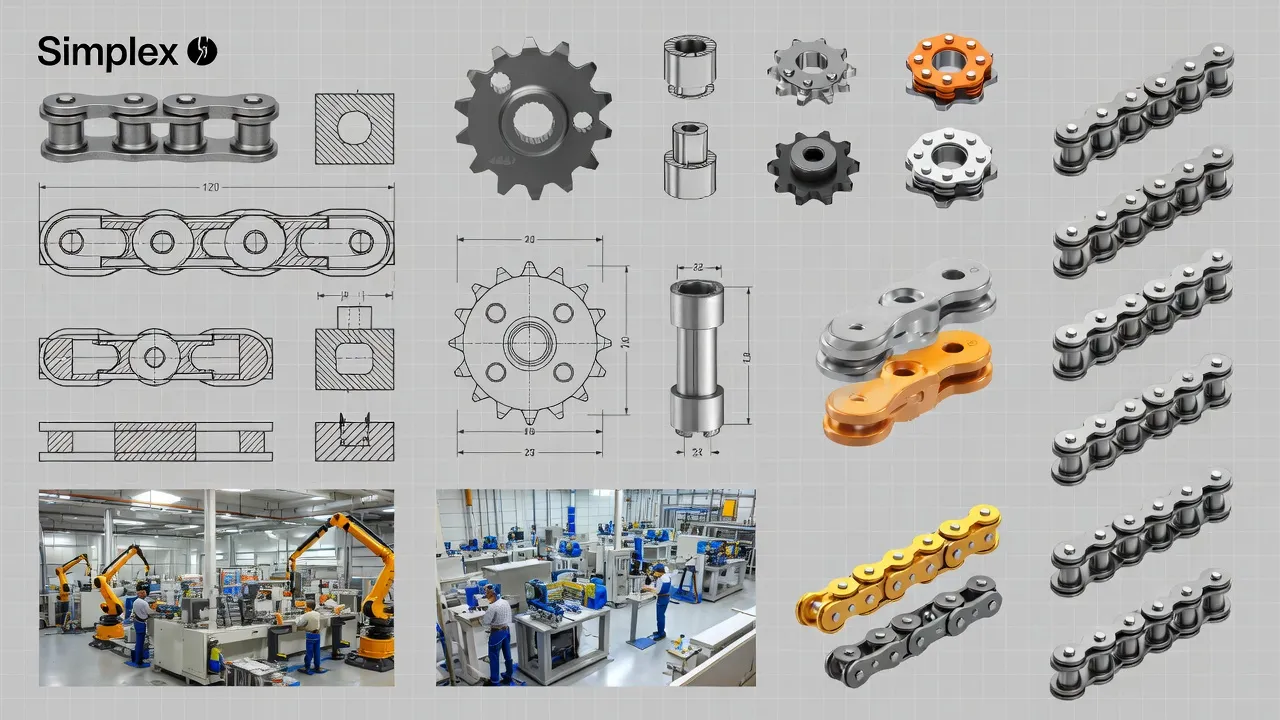
Designing Simplex Chain Drives for Automated System Reliability
Reliability engineering for automated system chain drives goes beyond standard industrial drive selection — it incorporates failure-mode analysis, redundancy considerations, and predictive maintenance integration from the design stage.
🛡️
Over-Rate the Selection
For automated systems where downtime is disproportionately costly, specifying one chain size above the minimum required by the power rating chart provides a safety margin against unexpected load increases, contamination-induced lubrication failures, and the moderate service factor uncertainty inherent in automation system commissioning. The additional chain cost is trivial against the avoided downtime cost of a single unplanned failure.
🔔
Integrate Wear Monitoring
Design the drive with accessible measurement points — a 300 mm straight-line section of chain on the tight strand, reachable with a vernier calliper without disassembly. For fully enclosed systems, specify an inspection port in the casing wall. On high-value automation systems, fit an ultrasonic or magnetic wear particle sensor to the oil-bath casing for continuous monitoring without operator intervention.
🔄
Plan Quick-Change Access
Design access panels sized to pass a replacement chain through without removing surrounding structure. On chain positions in robot cells or enclosed handling systems, a 15-minute chain replacement time target is achievable with the right access design — versus 4–6 hours on poorly accessible drives. The access design should accommodate the specific connecting link tool for the chain size, not just the chain itself.
Enter every chain drive in the facility’s CMMS with: chain size, installation date, initial elongation baseline, calculated replacement interval, and alert threshold at 1.5% elongation. CMMS-driven preventive maintenance for chain drives converts the entire fleet from reactive to predictive management without requiring any additional investment in monitoring hardware.
Maintenance Strategies for Automated Material Handling Chains
Automated systems present unique maintenance challenges: chains are often enclosed, difficult to access, and operating in environments where stopping the system to service a chain has significant production impact. The following strategies address these constraints while maintaining the monitoring required for predictive replacement.
🤖
Automated Lubrication Systems
Centralised automated lubrication systems deliver precisely metered oil to each chain drive through dedicated distribution lines, controlled by the facility’s PLC. Lubrication events are triggered by operating-time counters, eliminating human scheduling. For automated warehouses with hundreds of chain positions, central lube systems reduce maintenance labour for chain lubrication from 4–8 hours per week to quarterly system checks.
📡
Remote Wear Sensing
Magnetic wear particle sensors mounted in oil-bath casings measure metallic particle concentration in the lubricant in real time, providing a continuous wear-rate signal to the facility SCADA system. A rising particle count trend triggers a maintenance alert without requiring physical chain access. This technology is cost-effective on critical automation chains where the alternative — unplanned failure — carries disproportionate production loss cost.
🔋
Self-Lubricating Chain Selection
For fully enclosed automated systems where lubrication access is genuinely impractical without system shutdown, self-lubricating sintered-bush chains eliminate the external lubrication requirement entirely. The 5,000–10,000 hour lubrication-free service interval allows chain replacement to be the maintenance event — not the lubrication — making planning straightforward and reducing the number of maintenance entries into the automated system.
📊
Vibration-Based Monitoring
Accelerometers mounted on drive bearing housings detect the frequency signatures of chain elongation — the characteristic polygon-effect vibration increases as the chain wears. SCADA-integrated vibration monitoring provides continuous wear tracking without any operator intervention, and can detect a change in chain condition within 200–400 operating hours of its onset — far earlier than the next scheduled manual inspection.
Specialised Simplex Chain Types for Material Handling Applications
Material handling systems often require chain configurations beyond the standard simplex roller chain. The following variants extend the application range of simplex chain into specialised handling requirements while maintaining the core benefits of positive engagement and predictable wear.
| Chain Type |
Description |
Material Handling Use |
Key Advantage |
| K1 / K2 Attachment Chain |
Outer plates with upward or sideward extending plates at defined pitch intervals |
Slat conveyors, bucket elevators, product pushers |
Integral carrier system without separate hardware |
| Hollow Pin Chain |
Tubular pins allowing transverse bars or rods to pass through the pin bore |
Cross-bar conveyors, bottle handling, tray carriers |
Allows perpendicular attachment without welding |
| Roller Chain with Flights |
Extended plates or bolted-on flights perpendicular to the chain travel direction |
Bulk material drag conveyors, scraper conveyors |
Positive material movement in enclosed troughs |
| Double-Pitch Conveyor Chain |
Standard roller dimensions but 2× pitch for reduced weight on long slow circuits |
Slow product conveyors, long accumulation lines |
Lower chain weight reduces drive torque requirement |
| Side-Bow Chain |
Modified link geometry allowing horizontal curve navigation |
Curved accumulation conveyors, spiral conveyors |
Eliminates transfer points on curved conveyor paths |
Simplex Chain Drives in Industry 4.0 Automated Facilities
Industry 4.0 principles — connecting physical assets to digital monitoring, analytics, and automated decision-making systems — are increasingly applied to simplex chain drives in Australian automated facilities. The chain drive, traditionally a purely mechanical component, becomes a data-generating asset when equipped with appropriate sensors.
Digital Integration Example: An automated distribution centre installs vibration sensors on 240 chain drive bearing housings. Data feeds to a cloud-based predictive maintenance platform that analyses vibration frequency spectra against baseline profiles. The system identifies 12 drives with anomalous wear signatures 3–6 weeks before manual inspection would detect the same condition. Planned replacements are completed during the next scheduled weekly maintenance window. Zero unplanned stops result from chain failure in the following 18 months — a significant improvement on the previous year’s average of four chain-related stoppages per month.
For automated system chain specifications, engineering consultation, and supply programmes tailored to Australian distribution centres and manufacturing automation — visit Gear Drive Australia’s automation chain resources.
Contact the technical team at Gear Drive Australia for automated system chain selection, predictive maintenance programme design, and bulk supply agreements for Australian logistics and manufacturing automation facilities.
Frequently Asked Questions
What simplex chain is best for a robotic cell indexing drive? +
For robotic cell indexing drives that require positional accuracy within ±0.3–0.5 mm, specify short-pitch simplex chain (06B-1 or 08B-1) paired with high tooth count sprockets of 21–25 teeth minimum. Short pitch reduces the polygon-effect velocity variation below 1.5%, which is the threshold for stable positioning accuracy. Precision-ground rollers within ±0.01 mm diameter tolerance ensure consistent seating in each sprocket tooth valley — dimensional inconsistency in roller diameter causes positional variation that accumulates across multiple indexing cycles. For clean-room or food-grade robot cells, specify stainless-steel sealed simplex chains. For general manufacturing cells, case-hardened alloy chains with sintered self-lubricating bushings minimise lubrication requirements while maintaining the dimensional stability needed for repeatable indexing.
How do I prevent unplanned chain failures in an automated warehouse? +
Preventing unplanned chain failures in automated warehouses requires three parallel strategies. First, specify premium-grade self-lubricating chains for all drive positions — the maintenance-free lubrication characteristic eliminates the most common failure cause (lubrication deficiency) without requiring human intervention between annual service events. Second, implement a CMMS-based elongation tracking programme: every chain drive is assigned a periodic measurement task (monthly for high-utilisation drives, quarterly for lighter duty positions), with automatic replacement work orders generated when elongation approaches 1.5%. Third, establish minimum on-site spare chain inventory — one replacement circuit per drive size for the three most common sizes in the facility. Together, these three measures have eliminated unplanned chain failures at major Australian distribution centres that previously experienced 2–6 chain-related stoppages per month.
What is an attachment chain and when should I use it? +
An attachment chain is a standard simplex roller chain with additional plates or tabs welded or integrally formed at specified pitch intervals — typically every 2, 4, or 8 pitches. The attachments project perpendicular to the chain travel direction (upward, sideward, or at custom angles) and carry conveyor flights, product pushers, bucket hangars, or carrier hooks. K1 attachments have an upward-projecting plate on one side of the outer link; K2 attachments project on both sides. Hollow-pin attachment chains replace solid pins with tubular pins at the attachment positions, allowing transverse rods to pass through the pin bore — creating a cross-bar conveyor surface from two parallel chain runs. Use attachment chain whenever the conveyor element must be integrated directly with the drive chain without separate carrier hardware — reducing parts count, assembly complexity, and maintenance points compared with systems using separate conveyor chains driving separate carrier systems.
How often should automated system chains be replaced in a distribution centre? +
Replacement intervals in distribution centres vary widely based on the duty cycle, chain type, and lubrication system. For self-lubricating short-pitch chains in sortation systems operating 18–24 hours daily, a replacement interval of 12,000–18,000 operating hours is achievable with premium-grade chains — equivalent to 2–3 years of continuous operation before the 2% elongation threshold is reached. For attachment chains in product handling conveyors operating at lower speeds with heavier product loads, 8,000–12,000 hours is typical. Drive chains on AGVs with more variable load profiles typically require replacement every 8,000–15,000 hours depending on the load cycle. The definitive indicator in all cases is the 30-link elongation measurement at the 2% threshold — scheduled replacement at 1.5% elongation during a planned weekend maintenance window is the standard practice for critical automated warehouse chains, avoiding the risk of mid-shift failures on the highest-throughput operating days.
Can simplex chains be used in cleanroom or food-safe automation environments? +
Yes — simplex chains are used extensively in food-safe and cleanroom automation environments, with the appropriate material specification. For food contact zones in Australian food manufacturing, FSANZ-compliant chain specifications use 304 or 316 stainless steel construction with sealed sintered-bush joints that require no external food-contaminating lubricant. The entire chain assembly — plates, rollers, pins, bushings — uses food-grade stainless material, and any factory-applied lubricant is food-grade H1-registered. In pharmaceutical and cleanroom environments (ISO Class 6 and above), outgassing concerns limit the lubricants that can be used on chain drives inside the cleanroom boundary — PTFE dry-film lubricated chains or electropolished stainless chains with ceramic-coated bushings are the standard specifications for these environments. Both avoid the hydrocarbon contamination risk that mineral oils introduce into cleanroom air streams. All cleanroom and food-grade chain specifications should be confirmed against the facility’s specific regulatory requirements before procurement, as FSANZ food safety regulations and pharmaceutical GMP requirements impose material-specific restrictions that vary between product categories and processing stages.
How does chain elongation affect automated system positioning accuracy? +
Chain elongation accumulates as a positional offset that increases proportionally with the length of chain between the drive sprocket and the position reference point. For a robotic cell with 1,200 mm of chain in the indexing circuit, a 1% chain elongation adds 12 mm of cumulative positioning error distributed across all pitches. On a system calibrated to position within ±2 mm, this 12 mm offset will cause out-of-tolerance positioning before the chain reaches the standard 2% replacement threshold. This means robotic and precision indexing systems may need to replace chains at 0.8–1.2% elongation — before the standard industrial replacement threshold — and must recalibrate the position control system after each chain replacement to re-baseline the accumulated pitch error. Designing the system with a tension-adjustable takeup mechanism that compensates for chain elongation partially can extend the re-calibration interval, but cannot fully compensate for the distributed pitch error that occurs as elongation is non-uniform along the chain circuit.
What drives the decision between simplex chain and toothed belt in automation? +
The toothed belt versus simplex chain decision in automation applications turns on four parameters. Power level: toothed belts are competitive with simplex chain up to approximately 15 kW; above this, chain’s higher force-per-unit-width advantage becomes decisive. Shock tolerance: simplex chain absorbs shock loads significantly better than toothed belts, which are susceptible to tooth-skip under sudden torque spikes from crash stops, jam events, or robot motion profile peaks. Heavy shock applications always favour chain. Centre distance: both are viable at typical automation centre distances; toothed belt’s polymer construction allows use in environments where metallic sparks from chain engagement would be a hazard — a consideration in explosive-atmosphere automation zones. Operating life: under equivalent lubrication and load conditions, premium simplex chains typically outlast equivalent toothed belts by 1.5–2.5× in continuous operation, reducing the frequency of change events that require automated system downtime. In automation applications where high power, shock tolerance, and long replacement intervals are the dominant criteria, simplex chain is consistently the preferred specification.
How do I specify chain for a new pallet conveyor system in Australia? +
Pallet conveyor chain specification starts with the loaded pallet weight and conveyor speed. For typical Australian pallet conveyors carrying 500–1,500 kg pallets at 15–30 m/min, the chain friction force (pallet weight × conveyor friction coefficient) determines the working tension. A friction coefficient of 0.15–0.25 is typical for plastic pads on steel conveyor frames; multiply by the loaded pallet weight and the maximum number of pallets simultaneously on the conveyor to get the total friction force. Apply a service factor of 1.3–1.5 for smooth-running electric motor drives; 1.5–2.0 for stop-start cycles with inertia loads. Select the chain pitch from the power rating table at the drive shaft RPM. For multi-lane pallets conveyors where synchronisation is critical, ensure all lanes use chains from the same production batch — dimensional consistency within a batch is better than between batches, which matters for maintaining equal speed across lanes under variable product loading.
Can I integrate simplex chain drives with a PLC-based predictive maintenance system? +
Yes — simplex chain drives can be integrated into PLC-based predictive maintenance systems through several sensor types. Operating-hour counters are the simplest integration point — the PLC tracks hours on each drive and generates maintenance alerts at defined intervals programmed from the chain’s expected service life. Motor current monitoring from the VSD provides a continuous efficiency signal that rises as chain friction increases with wear, generating an alert when current exceeds the baseline by a set threshold (typically 5–8%). Vibration sensors on bearing housings provide frequency-domain analysis data that SCADA systems can trend against chain-wear signatures. Temperature sensors on bearing housings and chain surfaces — simple PT100 elements — provide a low-cost alternative to vibration analysis for detecting the heat-generating friction increase that accompanies lubrication degradation or wear acceleration. The key to successful PLC integration is establishing accurate baselines for each drive position at commissioning — the system cannot detect a change unless it has an accurate normal condition reference to compare against.
What chain lubricant is safe for automated food handling systems? +
For automated food handling systems where lubricant could contact food, the lubricant must be H1-registered (incidental food contact acceptable) under NSF International’s food-grade lubricant classification. H1 lubricants use synthetic base oils (typically PAO or food-grade silicone) with additives that meet FDA 21 CFR 178.3570 requirements. Common H1-rated chain lubricants include white mineral oil-based chains oils and food-grade PAO chain lubricants available in ISO VG 68, VG 100, and VG 150 grades to match drive speed requirements. In zones where food contact is possible and minimising lubricant application is preferred, self-lubricating chains with sintered-bush construction eliminate external lubricant application entirely from the food zone — only the factory-applied lubricant within the sealed sintered bush contacts the pin, and this never migrates to the chain outer surfaces in contact with food products. For Australian food manufacturers, confirm that any lubricant specified meets current FSANZ requirements in addition to NSF H1 registration, as FSANZ may impose additional restrictions on lubricant contact with specific food categories.
