
Description
Selecting the wrong worm gearbox can cost an industrial plant up to 18% in energy losses and shorten gear life by 40% under continuous duty. The MRV (NMRV-standard) worm gearbox series from Hangzhou Ever-Power Transmission Co., Ltd. is engineered for that exact problem — covering 10 frame sizes from MRV025 to MRV150, output torque from 11 to 1037 N·m, and reduction ratios from 5:1 up to 5000:1 in two-stage combinations. Built to ISO 14521 and DIN 3996 load-rating standards, every unit ships with synthetic ISO VG320 lubricant pre-filled, ground ZI-profile worms (56–62 HRC), and CuSn12Ni2 bronze worm wheels. This guide walks you through specifications, selection logic, installation, and total-cost-of-ownership data so you can specify the correct unit on the first attempt.
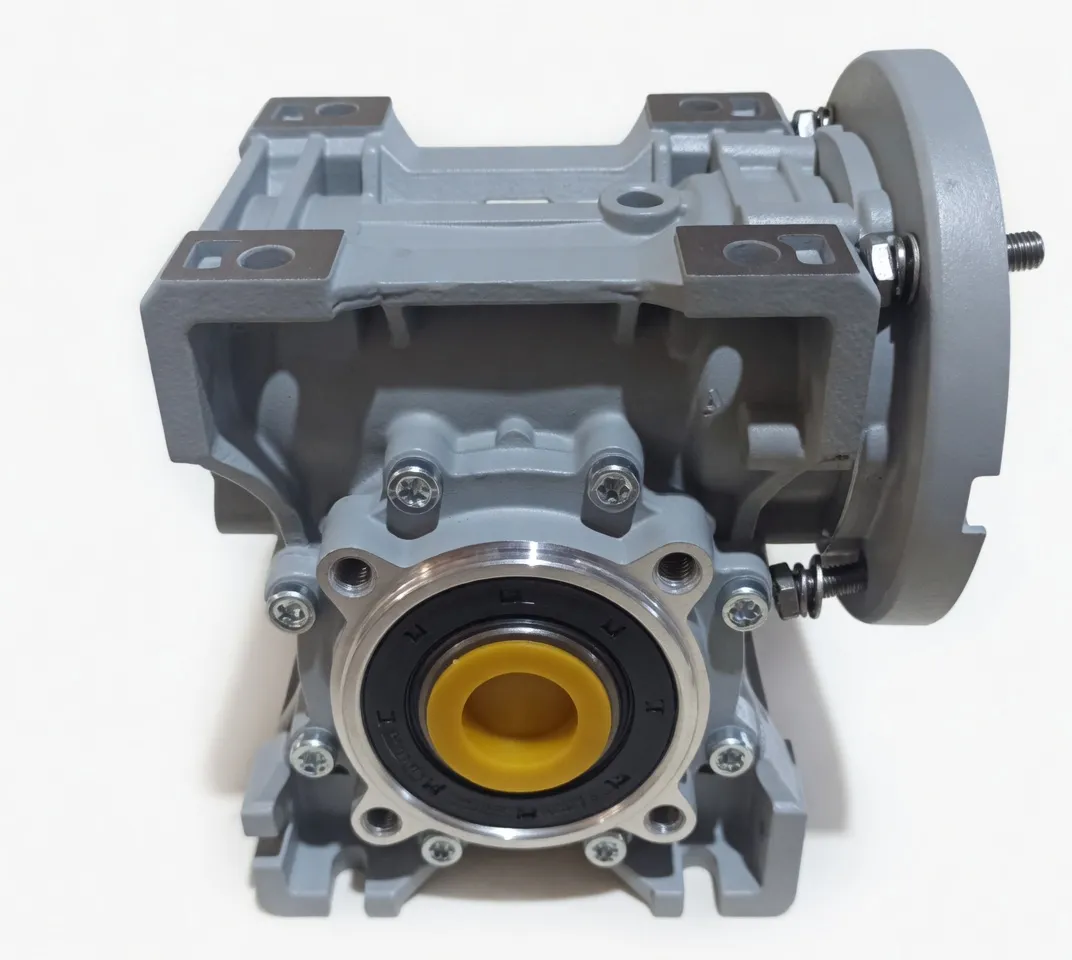
Key Specifications & Parameters of the MRV Worm Gearbox
The MRV series is dimensionally interchangeable with Motovario NMRV, Bonfiglioli VF/W, and SEW S-series gearboxes, allowing direct retrofit on existing machines. Frame sizes are designated by center distance in millimeters — for example, MRV050 has a 50 mm center distance between worm and wheel axes. Aluminum housings (sizes 025–110) are pressure die-cast for thermal dissipation; sizes 130 and 150 use G200 grey cast iron for higher torque density. The table below summarizes the rated output torque, input power, and weight at the most common 1400 rpm input speed and 25:1 ratio.
| Frame Size | Center Distance (mm) | Output Torque @ i=25 (N·m) | Input Power Range (kW) | Output Bore (mm) | Weight (kg) |
|---|---|---|---|---|---|
| MRV025 | 25 | 11 | 0.06–0.18 | 11 | 1.4 |
| MRV030 | 30 | 21 | 0.09–0.37 | 14 | 2.3 |
| MRV040 | 40 | 40 | 0.18–0.75 | 18 | 3.8 |
| MRV050 | 50 | 86 | 0.25–1.5 | 25 | 6.5 |
| MRV063 | 63 | 156 | 0.55–3.0 | 25 | 10.5 |
| MRV075 | 75 | 248 | 0.75–4.0 | 28 | 15.0 |
| MRV090 | 90 | 340 | 1.5–5.5 | 35 | 23.0 |
| MRV110 | 110 | 600 | 2.2–7.5 | 42 | 36.0 |
| MRV130 | 130 | 800 | 3.0–11 | 45 | 62.0 |
| MRV150 | 150 | 1037 | 4.0–15 | 50 | 85.0 |
What is an NMRV Worm Gearbox and How Does It Work?
A worm gearbox is a right-angle speed reducer that uses a screw-like worm shaft meshing with a bronze worm wheel to achieve high reduction ratios in a single stage. The MRV series follows the international NMRV standard, which defines the housing dimensions, mounting flanges (B5/B14 IEC), and output bore sizes adopted across European and Asian manufacturers since the 1990s. The mechanical advantage is generated because the worm rotates many times to advance the wheel by a single tooth — a 50:1 ratio means 50 worm revolutions produce one output revolution. This geometry delivers two benefits competing gear types cannot match: a compact 90° footprint and inherent self-locking at ratios above 30:1, where backdriving torque cannot overcome friction. The trade-off is mechanical efficiency, which ranges from 88% at 5:1 down to 52% at 100:1 per worm gearbox technical standards.
Types of MRV Worm Gearboxes by Configuration
The MRV platform supports five mounting configurations, each addressing a different installation constraint. Choosing the correct variant at the design stage avoids the most common field failure: misaligned coupling stress that destroys output bearings within 2,000 hours.
| Variant Code | Output Type | Best Application |
|---|---|---|
| MRV (basic) | Hollow shaft, foot-mounted | Conveyors, mixers, retrofit on existing shafts |
| MRV-F | Hollow shaft + output flange | Pumps, agitators, vertical drives |
| MRV-FA | Square output flange (B5) | Compact machinery integration |
| MRV-D | Solid double output shaft | Dual-side drives, gate openers |
| MRV-S | Solid single output shaft | Direct coupling to driven equipment |
All five variants share the same internal gearset, so torque ratings are identical — only the output interface differs. This modularity is what makes the NMRV standard the dominant worm reducer design globally, with an estimated 6.4 million units sold worldwide each year.
MRV Worm Gearbox Manufacturing Process
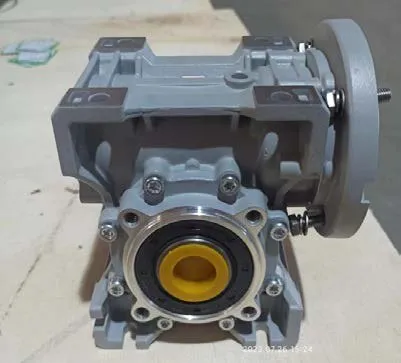
Every MRV unit produced at Hangzhou Ever-Power passes through eight controlled production stages. The aluminum housing begins as a high-pressure die-casting (cycle time 45 seconds, ADC12 alloy with 9.5% silicon for thermal stability), followed by CNC machining of the worm bore and output flange to a concentricity tolerance of 0.02 mm. Worm shafts are forged from 20Cr alloy steel, gas-carburized to a case depth of 0.3–0.5 mm, then ground on a CNC gear-grinding machine to AGMA Q10 surface finish. Worm wheels are gravity-cast in CuSn12Ni2 bronze (≥85 HB hardness) and hobbed on Gleason-pattern hobbing machines, then run-in for 20 minutes against a master worm to seat the contact pattern. Final assembly includes pre-filling with 0.05–4.5 L of synthetic PAG oil depending on frame size, vacuum-testing for leaks at 0.5 bar, and a 100% no-load run test before packaging. Ever-Power has produced power-transmission components since 1988, applying continuously refined tooling and process control across more than three decades of manufacturing experience.
How to Select the Right Worm Gearbox: A 5-Step Engineering Method
Use this worm reducer selection method in order — skipping steps is the most common cause of premature failure.
- Determine required output torque (T₂): Calculate from driven load, multiply by service factor SF (1.0 for uniform load, 1.25 for moderate shock, 1.75 for heavy shock). Example: a conveyor needing 80 N·m at 1.25 SF requires a unit rated for at least 100 N·m.
- Calculate reduction ratio (i): i = motor RPM ÷ required output RPM. A 1400 rpm motor driving a 28 rpm conveyor needs i = 50:1.
- Select frame size from torque table: Choose the smallest frame whose rated torque at your ratio meets or exceeds the SF-adjusted load.
- Verify thermal capacity (P_T): For continuous S1 duty above 30% load, confirm P_T exceeds absorbed power. Aluminum frames dissipate 15–25% less heat than cast iron — derate by 0.85 in ambient above 35°C.
- Confirm radial/axial overhung load (FR/FA): Check shaft load capacity against catalog limits at your application’s distance from the housing face.
Hangzhou Ever-Power supplies all required worm gearbox spare parts alongside complete units — output shafts, torque arms, output flanges, dust covers, and replacement worm-and-wheel sets — so you can assemble a customized configuration without sourcing from multiple vendors.
Worm Gearbox Applications Across Global Industries
MRV worm gearboxes drive equipment across five primary sectors worldwide. In food and beverage processing, frame sizes MRV050 to MRV090 power conveyor belts, bottle washers, and dough mixers, where the self-locking property prevents conveyor backslide during power loss. Mining operations across Australia, Chile, South Africa, and Indonesia deploy larger MRV110–MRV150 units on coal samplers, slurry valves, and ore-sorting feeders. The packaging sector uses smaller MRV030–MRV050 units on case erectors, label applicators, and tray dispensers operating up to 80 cycles per minute. Agricultural machinery — particularly grain augers, silo discharge gates, and rotary feed mixers — accounts for roughly 22% of annual MRV demand, with concentrated installations in North America, Europe, and Southeast Asia. Building services account for around 12% of MRV demand globally, primarily in roller-shutter doors and HVAC damper actuators. Hangzhou Ever-Power exports MRV-series gearboxes to over 60 countries including Germany, the United States, Canada, Spain, Australia, Turkey, India, and across the Middle East, supported by regional warehousing in Singapore and Italy.
Worm Gearbox Spare Parts & Components We Supply
Hangzhou Ever-Power also stocks individually-ordered components for repair, retrofit, and custom-build applications. All parts are produced to OEM specifications and dimensionally interchangeable with NMRV-standard gearboxes from any manufacturer.
- Worm gear shafts: Straight or tapered, in C45 steel, stainless 304/316, brass, or POM. Module M1–M12, DIN6–DIN9 precision, tolerance ±0.001 mm achievable on request — see our metric worm gear specifications for full options.
- Worm wheels: Brass (CuSn12Ni2 or ZQAl9-4), stainless steel for CNC machinery, alloy steel for automotive components, and engineering plastic for low-load applications.
- Worm-and-wheel matched sets: Pre-lapped pairs supplied with verified contact pattern (≥75% mesh contact per AGMA 6034).
- Output shafts and flanges: Machined from C45 induction-hardened steel, 56–60 HRC at the bearing journals.
- Bearings, oil seals, dust covers, and torque arms: SKF/NSK-grade bearings, Viton or NBR seals rated to 100°C continuous.
How to Maintain a Worm Gearbox for 30,000+ Hour Service Life
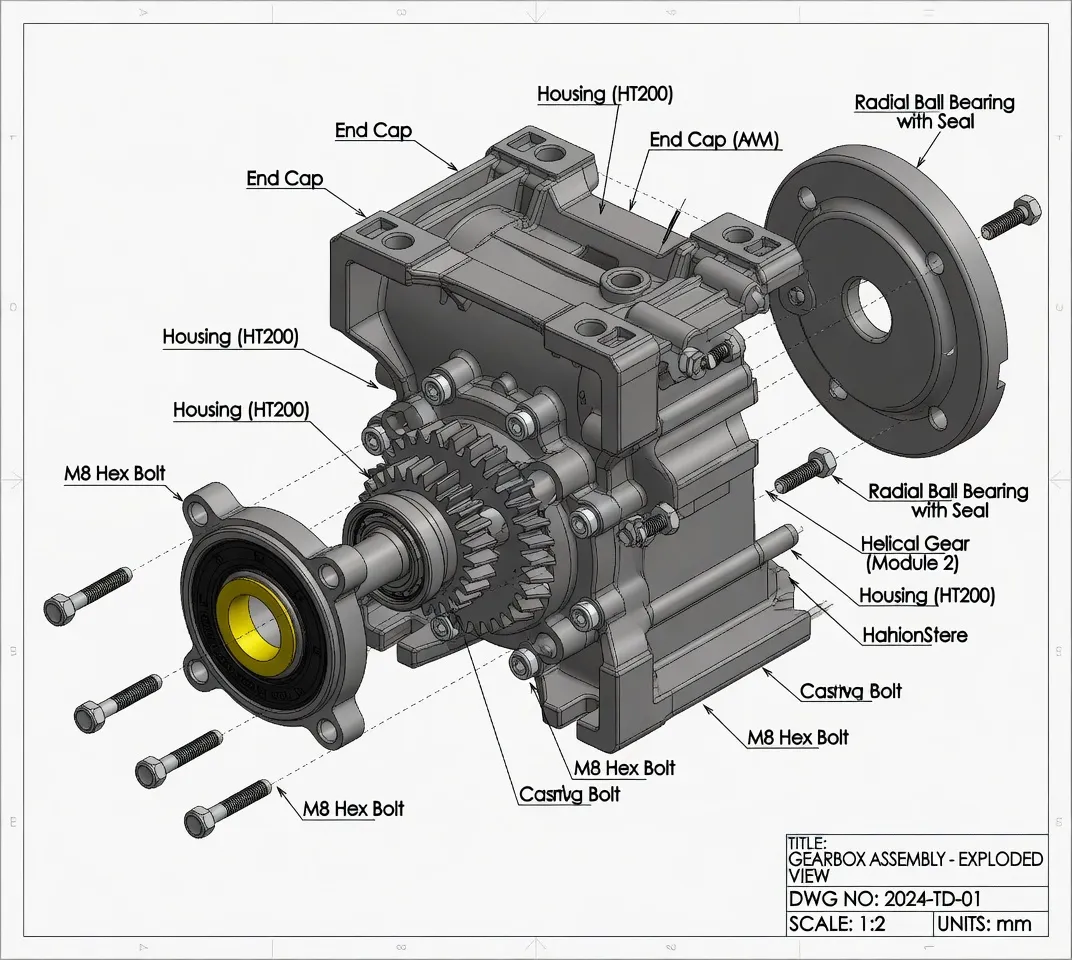
Aluminum-housed MRV units are pre-filled with synthetic PAG lubricant rated for 25,000–30,000 hours, meaning most installations require no oil change for the entire service life. Cast iron MRV130/150 units use ISO VG320 mineral oil with a recommended change interval of 8,000 operating hours or 24 months, whichever comes first. Inspect the breather plug monthly during the first 500 hours; particles in the magnetic drain plug indicate worm-wheel wear. Surface temperature during steady-state operation should not exceed ambient + 50°C — anything higher signals overload, undersized cooling, or lubricant degradation. For food-industry installations, switch to NSF H1-certified oil at the first scheduled change. Learn more about Ever-Power’s quality systems that ensure every unit meets these performance benchmarks.
Why Choose Hangzhou Ever-Power as Your Worm Gearbox Manufacturer
Hangzhou Ever-Power Transmission Co., Ltd. has manufactured power-transmission components since 1988, with operations spanning helical gear reducers, planetary gearboxes, worm reducers, agricultural gearboxes, and PTO drive shafts. Our Hangzhou production base — located on Shenhua Road — operates CNC gear-grinding machines, gear shapers, machining centers, and an in-house metallurgy lab certified to ISO 9001:2015. Lead time for stock MRV025–MRV090 is 7 working days; custom configurations including non-standard ratios, special shafts, or stainless variants ship within 21 days. Every unit carries a 24-month warranty with field-replaceable bearings and seals. As part of the EVER-POWER Group, we maintain regional offices in Singapore and Italy, providing technical support and faster fulfillment to customers across Southeast Asia, the Middle East, Europe, the Americas, and Oceania.
What Customers Say About the MRV Worm Gearbox
“We replaced six failing imported worm gearboxes on our almond sorting line with MRV075 units last March. Twelve months in, zero failures and the running temperature is 8°C lower. The CuSn12Ni2 bronze wheel is noticeably better material than what we’d been using.”
— David M., Maintenance Engineer, almond processing facility, Australia
“Specified MRV050 with B14 flange for a custom packaging machine. Dimensions matched our existing CAD model exactly — drop-in replacement for the Italian unit we’d previously imported, at 38% lower delivered cost. Documentation was thorough and Ever-Power’s technical team answered ratio questions within hours.”
— Markus B., Mechanical Designer, packaging OEM, Germany
“Bought 14 × MRV040 units for a poultry feed conveyor upgrade. The self-locking at 60:1 ratio is exactly what we needed to hold load when the line stops. Delivered in 19 days from Hangzhou to our Iowa facility, all units functional, packaging undamaged.”
— Kane T., Plant Manager, agricultural equipment installer, United States
“Sourced MRV110 with double output shaft for a custom gate-opener prototype. The technical drawings Ever-Power provided in DXF format saved us roughly 6 hours of measurement work. Ratio was custom 80:1 and arrived correctly first time.”
— Rajesh K., Product Engineer, access-control manufacturer, India
Frequently Asked Questions About the MRV Worm Gearbox
Q1: What is the difference between MRV and NMRV worm gearboxes?
MRV is Ever-Power’s series designation for gearboxes built to the international NMRV dimensional standard. They are functionally identical and interchangeable — same center distance, same mounting bolt pattern, same output bore. The “M” prefix simply identifies the manufacturer in our part numbering system.
Q2: At what ratio does a worm gearbox become self-locking?
Self-locking begins around 30:1 and is reliable above 40:1 under static conditions. However, “self-locking” is conditional — vibration, shock load, or oil film breakdown can release the lock. Never rely on self-locking alone for personnel safety; always specify a separate brake for lifting applications.
Q3: Can MRV worm gearboxes operate in any mounting position?
Aluminum-housed sizes (MRV025–MRV110) are factory-filled with synthetic oil suitable for any mounting position (B3, B6, B7, B8, V5, V6) without modification. Cast-iron MRV130 and MRV150 require position-specific oil quantities — specify the mounting orientation when ordering.
Q4: How do I calculate efficiency for my specific ratio?
Worm gearbox efficiency drops as ratio increases. Approximate values: 5:1 ≈ 88%, 10:1 ≈ 84%, 25:1 ≈ 72%, 50:1 ≈ 62%, 100:1 ≈ 52%. For precise calculation in design verification, use η = tan(λ) / tan(λ + φ), where λ is the worm lead angle and φ is the friction angle (typically 1–2° with synthetic oil).
Q5: What is the minimum order quantity and lead time for international delivery?
No minimum order — single units are available for stock sizes MRV025 through MRV110. Lead time is 7 working days ex-works for stock items, plus 18–35 days sea freight depending on destination port. Air freight to major cities is typically 5–7 days for urgent requirements. Contact our worm gearbox specialists for a project quote.
Q6: Do MRV gearboxes meet AGMA and DIN standards?
Yes. Load rating follows ISO 14521 and DIN 3996; gear quality is AGMA Q10 ground; bearings are rated per ISO 281; shaft fatigue per DIN 743. Material certificates and dimensional inspection reports are available with every order on request.
Ready to Specify Your MRV Worm Gearbox?
Get a custom quote with frame size, ratio, mounting, and shipping cost — typically within 8 hours.